
 简体中文
 English
 Русский
A wash-bay pump keeps running long after the trigger is released. The coil clicks, the plunger moves, the seat stays open, and the operator blames the coil. More often the seat is packed with scale, or the valve was bought as normally open when the line needed normally closed.
That pattern repeats across filling machines, irrigation headers and cooling loops. A two way solenoid valve is a simple component, and it usually fails for specification reasons rather than mechanical ones. It has two ports and two positions, one flow path between them, and no modulation and no bypass. Once that is clear, most buying decisions come down to four questions: which state should the valve hold with the power off, should it be direct-acting or pilot-operated, what body and seal material suits the fluid, and what coil rating survives the ambient temperature.
Content
- 1 How a two way solenoid valve works
- 2 Normally closed or normally open: decide the failure state first
- 3 Direct-acting or pilot-operated: the pressure differential decides
- 4 Body material, seals and coil class
- 5 Installation, sizing and the callbacks worth avoiding
- 6 Frequently asked questions
- 6.1 What is a two way solenoid valve used for?
- 6.2 What is the difference between a 2 way and a 3 way solenoid valve?
- 6.3 What does normally closed mean on a solenoid valve?
- 6.4 Can a two way solenoid valve be used for water?
- 6.5 Why is my 2 way solenoid valve not opening?
- 6.6 Should I choose an AC or a DC coil?
- 7 What to send a supplier
How a two way solenoid valve works
A two way solenoid valve is written 2/2 in catalogues: the first figure counts the ports, the second counts the positions the internal member can take. There is one path between inlet and outlet, and the valve either blocks it or opens it. Instrumentation engineers often compare it to a single-pole switch — one line in, one line out, on or off.
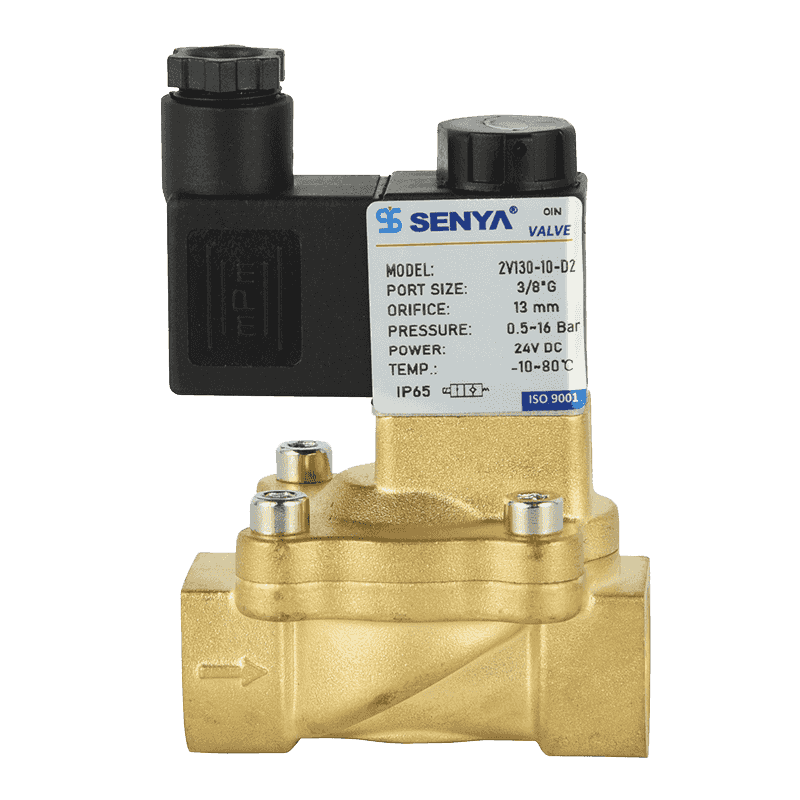
The parts count is small. A coil sits over a fixed core and a moving plunger; a return spring pushes the plunger back; a seal or diaphragm closes the orifice; the body carries the two ports. Energise the coil and the magnetic field pulls the plunger, the seal lifts off the orifice, and line pressure pushes fluid through. Cut the power and the spring drives the seal back onto the seat.
Because there is no third port, a 2/2 valve cannot exhaust downstream pressure or divert flow. If the circuit needs to bleed a cylinder or switch between two lines, that is a 3/2 or 5/2 job.
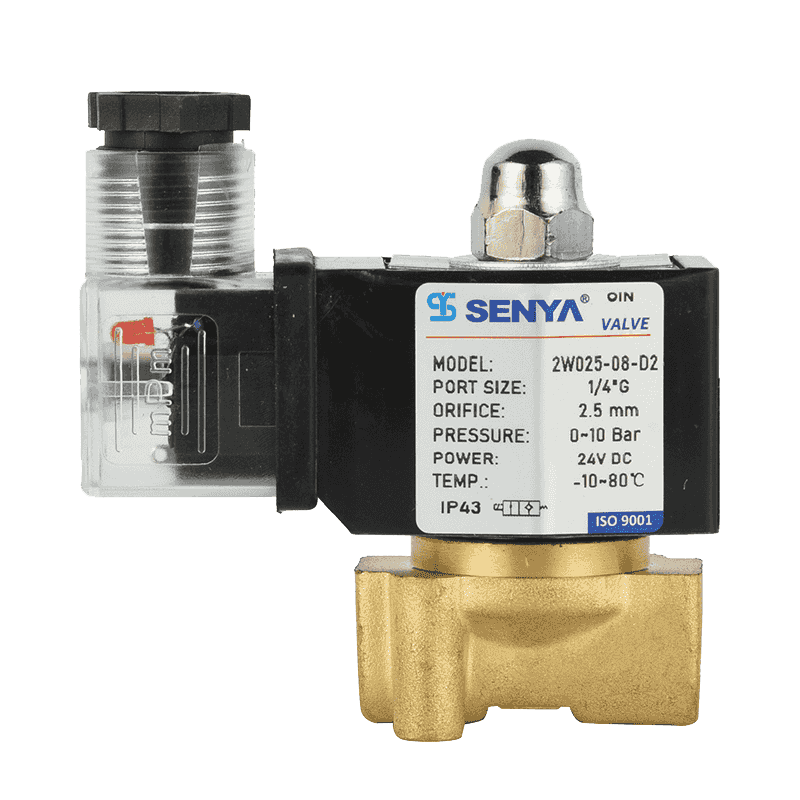
 2W Series Brass 2/2-Way Water Solenoid ValveFor air, water and light oil duty in general automation, this 2W brass valve offers zero differential start and high impurity tolerance.View Product →
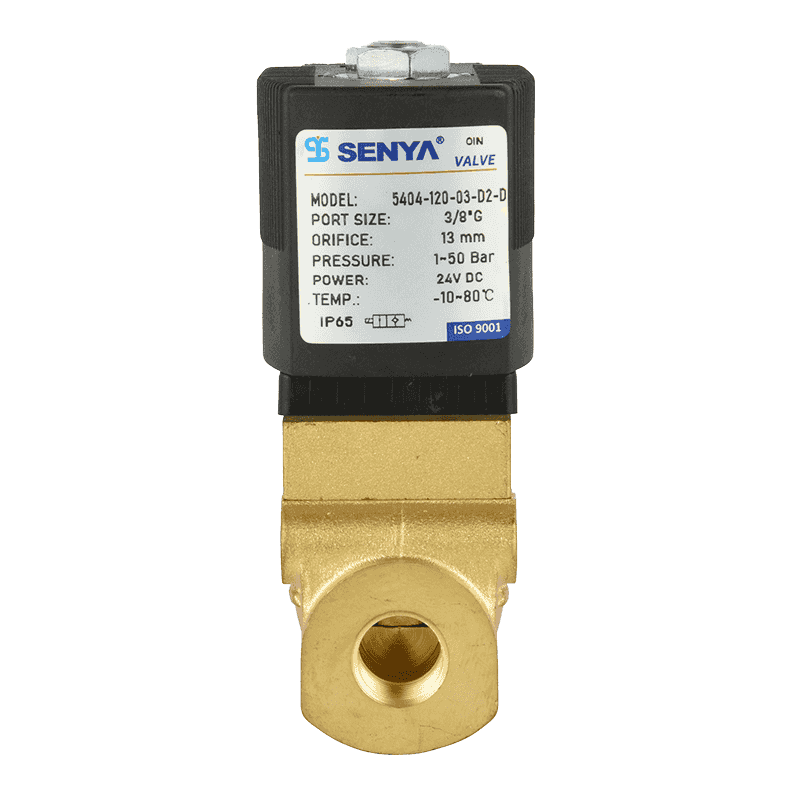
Typical brass bodies such as the 2W series cover air, water and light oil duty across the small and mid port sizes that most general automation uses, which makes them the sensible starting point before moving to a speciality material.
Normally closed or normally open: decide the failure state first
Choose the de-energised state before anything else. Normally closed (NC) blocks flow with no power and opens when the coil is energised; normally open (NO) does the opposite. It is a process question, not a price question: what should happen to the fluid when the control system loses power or the coil burns out?
| Aspect | Normally closed (NC) | Normally open (NO) |
|---|---|---|
| State with no power | Closed, flow blocked | Open, flow passes |
| Energised state | Coil energised to open | Coil energised to close |
| Typical duty | Fill, dosing, shut-off, zone irrigation, coolant to a tool | Cooling loops, venting, drains, circuits that must not dead-head |
| Coil exposure | Energised only during the active cycle | Energised most of the operating day, so warmer on average |
| Behaviour on coil failure | Flow stops — usually the safe outcome | Flow continues — confirm that is acceptable |
| Common buying error | Fitted where a cooling circuit must stay open | Fitted where an empty tank must not keep filling |
Two practical notes. A NO valve holds its coil energised for most of its life, so check the duty rating and expect a warmer body. And on most designs the coil can be rotated on the valve stem, so mount it with the cable gland pointing down rather than sideways — the flow path is unaffected, but water ingress risk is not.
Direct-acting or pilot-operated: the pressure differential decides
A direct-acting valve uses coil force alone to lift the seal. It opens at zero pressure and is the safe pick for empty lines, gravity feed and pump-down cycles. The limit is force: as port size grows, the same coil cannot lift a large seal against line pressure, so flow capacity per body size falls.
A pilot-operated valve uses the coil only to open a small pilot orifice; line pressure then does the work of moving the main diaphragm. The payoff is high flow from a small coil. The cost is a minimum differential. Datasheets quote it — often a few tenths of a bar on general-purpose models — and it has to be met at the valve, not back at the compressor.
The comparison above is qualitative, taken from how each design works rather than from measured test data. Use it to shortlist, then confirm the real numbers on the datasheet for the exact model.
One field symptom is worth remembering. If the pilot line can see zero gauge pressure during start-up, the valve will sit closed even with the coil energised, and the maintenance report will read "dead coil" when nothing is wrong with the coil at all.
Body material, seals and coil class
Material choice is decided by the fluid and the environment, not by habit.
- Brass: water, compressed air and neutral gases; the default for general automation and car-wash equipment.
- Stainless steel 304 or 316: food and beverage lines, medical sterilisation, outdoor installations and mildly aggressive media.
- Plastic: dilute acids and dosing lines where metal ions are unacceptable.
- Cast iron, flanged: mains water, large irrigation headers and high-impurity water.
Seals matter as much as the body. NBR suits water, air and light oil; EPDM handles hot water and many chemicals but dislikes mineral oil; FKM covers oils, fuels and more aggressive media. Confirm compatibility for the actual concentration and temperature before ordering.
A Class F coil rated to a 155 °C winding is not a licence to run it in a 60 °C cabinet. The class sets the winding limit; ambient temperature, enclosure protection and duty cycle decide how close you actually get to it. Continuous duty with a hot ambient is where undersized coils fail — usually as an open winding after a few months, not on day one.
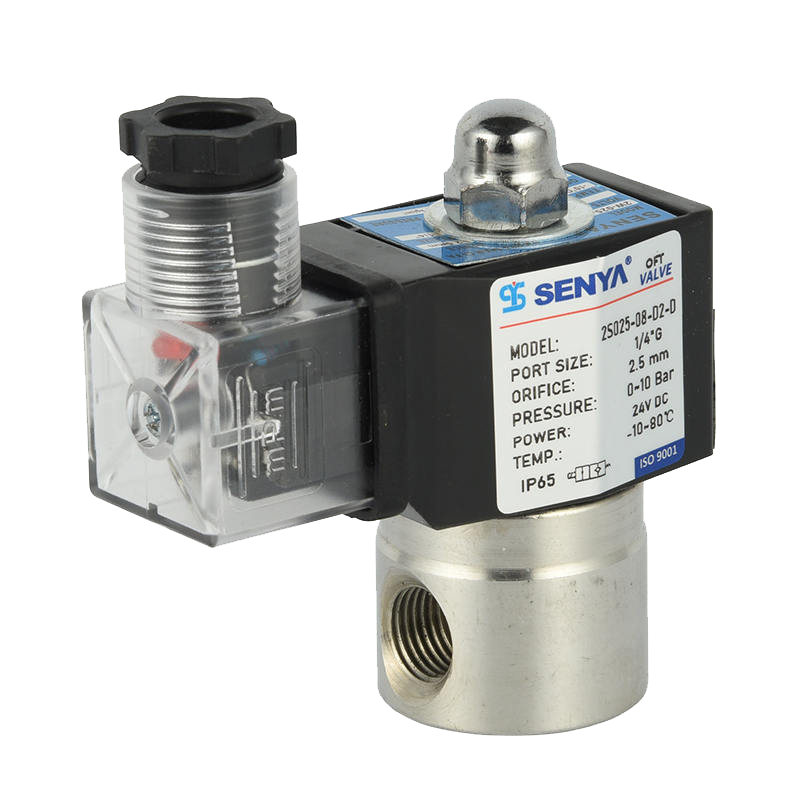
 2S Series Direct-Acting Stainless Steel Solenoid ValveDirect-acting 2S valve in SUS304 with Viton seals suits acid, alkali and harsh media where brass would discolour or pit.View Product →
Stainless bodies such as the SUS304 2S series are specified where the medium, the cleaning regime or the outdoor location would pit or discolour brass over time.
Installation, sizing and the callbacks worth avoiding
Size on flow, not on thread. A larger port is not automatically better: if the coil cannot open the seal against the working pressure, extra bore buys nothing but a bigger bill.
- Select by required flow and acceptable pressure drop using the Cv or Kv figure, then check the differential the design needs.
- Respect the flow arrow. Most 2/2 valves are directional and will leak or chatter when reversed.
- Fit a strainer upstream. Scale, swarf and thread sealant are the most common reason a valve clicks but will not pass.
- Mount with the coil upright where space allows, so debris does not settle onto the seat.
- Check the maximum ambient and the duty cycle; add a freewheeling diode on DC coils and a snubber on AC coils driven by relays or triacs.
- Match the seal to the medium, not to what was in the stores.
For a step-by-step walk-through of port size, seal and coil selection, this guide to choosing the right 2/2 way solenoid valve covers the same checklist in more depth, including the pressure-differential trap on pilot designs.
 Music Fountain Submerged Water Column Control ValveFor music fountain water columns, this sealed brass 2/2-way valve supports fast rhythm control and can be immersed, with IP6X protection.View Product →
Where the valve lives in a wash bay, an outdoor irrigation pit or a food plant that gets hosed down, a sealed, water-proof coil and plug assembly is worth more than a small saving on the unit price.
Frequently asked questions
What is a two way solenoid valve used for?
On/off control of a single line. Typical duties are water filling, zone irrigation, cooling loops, compressed-air isolation and light-oil dosing. It opens or closes one path; it does not mix, divert or regulate.
What is the difference between a 2 way and a 3 way solenoid valve?
A 2 way valve has two ports and one flow path. A 3 way valve has three ports and can divert flow between outlets or act as a pilot exhaust, which is why it appears in cylinder and actuator circuits.
What does normally closed mean on a solenoid valve?
The valve is shut with no power applied and opens only while the coil is energised. It is the usual choice where a power loss must stop flow, such as a filling nozzle or a chemical dose line.
Can a two way solenoid valve be used for water?
Yes. Use a brass or stainless body with NBR or EPDM seals, keep debris out with an upstream strainer, and confirm the pressure range covers both the static and the flowing condition.
Why is my 2 way solenoid valve not opening?
On pilot-operated models the usual cause is missing pressure differential. Otherwise check coil voltage, a clogged pilot orifice or strainer, a swollen seal, or a plunger held by scale.
Should I choose an AC or a DC coil?
AC coils draw a high inrush current and can chatter on a dirty supply. DC coils run more quietly and suit PLC outputs and battery systems; 24 V DC is the common automation choice.
What to send a supplier
Five details settle most orders quickly: the medium, the minimum and maximum line pressure, the ambient temperature around the coil, the port size and required flow, and the state the valve must hold with the power off. Voltage and duty cycle complete the picture.
If you would rather check a specification against a real application before committing, send those details through our contact page and we will confirm port size, seal material and coil class for the duty you describe.