
 简体中文
 English
 Русский
A cylinder that creeps, or a solenoid valve that seems to lose response halfway through a shift, usually gets the blame first. In many pneumatic lines the real cause sits a metre upstream: a filter element that has been carrying oil, water and pipe scale long after its media was saturated. Changing the housing solves nothing, because the element is the part doing the separating work.
The conclusion first: the filter element, not the housing or the nameplate, decides what your compressed air carries downstream. Three things have to line up — the micron rating against the contamination you must remove, the media against the fluid's chemistry and temperature, and the flow area against the duty cycle. Get one of them wrong and you either burn compressor energy for nothing or push dirt into the valve and cylinder you were trying to protect.
The sections below cover how an element captures particles, how to read nominal versus absolute ratings, what the internal parts are made of, and how to judge when a replacement is genuinely due.
Content
- 1 What a filter element does inside the housing
- 2 Micron ratings: nominal, absolute and the label trap
- 3 Construction: the parts that decide element life
- 4 Sizing: pressure drop decides when the element is finished
- 5 Matching the element to the machine it protects
- 6 Replacement: gauge first, calendar second
- 7 Five checks before you place the order
- 8 Frequently asked questions about filter elements
- 8.1 What is a filter element?
- 8.2 How often should a pneumatic filter element be replaced?
- 8.3 What is the difference between nominal and absolute micron rating?
- 8.4 Can a filter element be cleaned and reused?
- 8.5 What causes high pressure drop across a filter element?
- 8.6 How do I choose the right filter element size?
What a filter element does inside the housing
The housing is a pressure boundary with an inlet, an outlet and a bowl. The element is the replaceable pack of media inside it, and it is the only part that removes particles and liquid aerosols from the stream. Three mechanisms work at the same time:
- Direct interception: particles larger than the gaps between fibres cannot pass and lodge in the media.
- Inertial impaction: heavier particles cannot follow the air as it bends around a fibre and hit the surface head-on.
- Diffusion: very fine particles move randomly and are caught by contact with the fibre, which is why good fine grades still work below one micron.
In an oil-coalescing element the fibres are also treated to shed liquid. Aerosols merge into droplets on the media, the droplets migrate to the pleat tips, and gravity carries them into the bowl where a drain can remove them. That is why a coalescing element needs a properly sized bowl and a working drain, not just good media.
What an element cannot do: it will not remove oil vapour (that needs activated carbon), it will not remove water vapour (that needs a dryer), and it will not recover once the media is blinded — washing a pleated coalescing element rarely brings efficiency back to its original level.
Micron ratings: nominal, absolute and the label trap
Two elements can both be sold as "5 micron" and behave nothing alike. A nominal rating is a loose description with no fixed test method behind it. An absolute rating comes from a defined test, usually expressed as a beta ratio: a beta ratio of 200 at 3 µm means that of 200 particles of that size entering the element, one passes — 99.5% removal. Always ask which of the two you are buying.
The test standard matters as much as the number. Hydraulic elements are commonly rated under multi-pass methods such as ISO 16889, while compressed air filters are usually described against ISO 8573-1 purity classes or a manufacturer's own filter grades. If the data sheet does not state the method, the figure is marketing rather than specification.
| Label on the element | What it usually means | What to verify before ordering |
|---|---|---|
| "5 micron" (nominal) | Loose description, no fixed test method | Ask for the absolute rating and efficiency |
| Absolute or beta rating | Efficiency at a defined particle size | Confirm the test standard and the size used |
| Efficiency percentage | Removal performance at a stated size | Check the size, not only the percentage |
| ISO 8573-1 class | Air purity class for the system | Match the class to the equipment downstream |
| Part number or series | Physical fit and media grade | Cross-check housing series, seals and dimensions |
Construction: the parts that decide element life
A pleated element is a small assembly, and every part in it has a job. End caps bond the pleats and set the seal; the perforated support core resists collapse; the outer cage protects the media during handling; the gasket keeps unfiltered air from bypassing the pack entirely.
Low cost and good for dry dust and general pre-filtration, but the media swells and weakens if it stays wet.
The usual choice for coalescing grades: fine fibres catch aerosols and release the liquid towards the bowl.
Rigid and reusable after cleaning, suited to high temperature and rough pneumatic duty, though pore distribution is wider.
Corrosion resistance plus mechanical strength; often a support layer or a washable pre-filter rather than a fine stage.
Removes oil vapour and odour rather than particles, saturates quietly, and therefore has to be tracked by date.
Hydrophobic and chemically broad, used where liquid water or aggressive media would destroy a paper pack.
The support core and cage matter as much as the media in pulsating duty. A weak cage can collapse during a blocked-element event and send media fragments downstream, a failure that usually looks like valve contamination rather than a filter problem.
Sizing: pressure drop decides when the element is finished
An element is not full at a fixed date. It is full when the differential pressure across it reaches the level the manufacturer specifies, commonly marked as a red zone on the housing gauge and often in the 0.5 to 0.7 bar range for compressed air service. Pressure drop rises roughly with the square of flow, so an element that looks healthy at half load can be marginal at rated flow.
Undersizing costs energy every hour of operation. A widely used rule of thumb in compressed air engineering holds that each additional bar of working pressure costs roughly 6 to 8% more compressor energy, which makes a permanently high differential pressure a running cost rather than a one-off purchase price.
Check the rated flow at the pressure and temperature you actually run, not the headline catalogue figure. An element rated at 7 bar behaves differently at 4 bar, and the correction factors in a decent data sheet exist precisely for that reason.
Matching the element to the machine it protects
In a pneumatic line the element normally lives in the air treatment unit — filter, regulator and lubricator combined, or a dedicated filter ahead of the valves. SENYA, a Ningbo-based pneumatic manufacturer with production dating back to 1994, follows the usual staged logic: a general-purpose filter to take out pipe scale and water, a fine coalescing stage for oil aerosol, and a carbon stage for vapour where the process demands it. More detail on the company's range is set out in its manufacturing background.
The FRLS series air treatment unit is the common starting point when an element has to protect valves and cylinders on a general workshop line; what you specify is the element grade and the bowl size, not the colour of the housing.
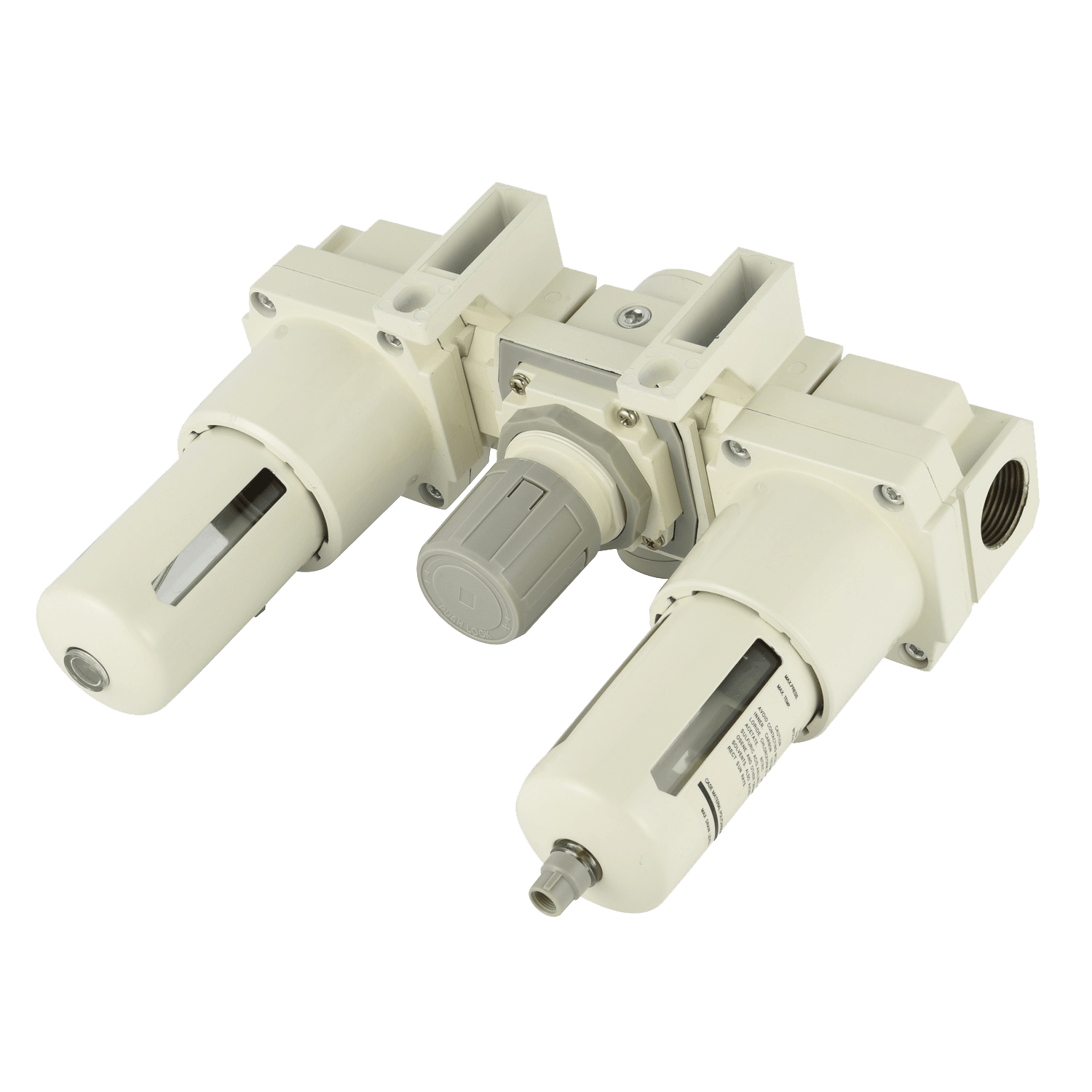 AEC Series Filter-Regulator-Lubricator Combination UnitA three-in-one air treatment unit for lines requiring filtration, pressure regulation and lubrication; it offers 0–1.0 MPa pressure resistance and 1/4–1 in ports.View Product →
Where space is tight and the line needs a compact filter-regulator arrangement, the AEW series air treatment unit covers a similar filtration duty in a more modular body format.
 AEW Series Filter-Regulator with Round Pressure GaugeA compact two-in-one filter-regulator for pneumatic lines, with round gauge, 0–1.0 MPa pressure resistance and 40 µm standard filtration.View Product →
Whoever supplies the element, confirm four compatibility points before ordering: housing series and part number, seal material against the fluid, port and bowl thread, and rated flow at your working pressure. A part that fits but is one grade coarser will pass the air and miss the oil.
Replacement: gauge first, calendar second
Fixed six-month or twelve-month intervals are easy to administer and often wasteful. A better sequence is to read the differential pressure gauge, then look at the bowl, then check downstream symptoms:
- Water or oil reaching the bowl outlet or a downstream trap faster than before.
- Cylinder speed creeping down, or a valve needing higher pilot pressure to shift.
- Air instruments drifting, or nozzles blocking on the same machine.
- Compressor duty rising without a change in production output.
Where contamination is heavy, staged filtration does more than a finer single element. A 5 µm pre-filter ahead of a 0.01 µm coalescing stage keeps the fine element from blinding within weeks, and the pre-filter is the cheap one to change. The layering logic is explained further in this note on how multistage filtration intercepts pollutants layer by layer.
| Symptom | Likely cause | Action |
|---|---|---|
| Rising differential pressure at normal flow | Media loading | Replace the element and check the pre-filter |
| Oil in the bowl after the element | Coalescing stage saturated or wrong grade | Verify the grade, replace, inspect the drain |
| Swollen media or housing corrosion | Water carryover, no effective drying | Fix upstream drying, change media type |
| Media fragments found downstream | Collapsed cage or incorrect element | Check the cage, verify part number and Δp limit |
Five checks before you place the order
- Absolute rating and efficiency at the particle size that actually damages your equipment, not the nominal number on the box.
- Media and seal compatibility with the fluid, the lubricant and the temperature range, including washdown chemicals in food and beverage lines.
- Rated flow at working pressure, with the manufacturer's correction factors applied rather than ignored.
- Physical fit: housing series, end-cap design, gasket profile and enough bowl clearance for the drain.
- Replacement data: differential pressure limit, expected service interval and whether a cross-reference chart exists for the housings already installed.
Frequently asked questions about filter elements
What is a filter element?
It is the replaceable media pack inside a filter housing that separates particles and liquid aerosols from air, gas or oil. The housing holds pressure; the element performs the filtration.
How often should a pneumatic filter element be replaced?
On differential pressure rather than on a fixed date. Replace when the gauge reaches the limit set by the manufacturer, commonly around 0.5 to 0.7 bar, or sooner if oil carryover and downstream symptoms appear.
What is the difference between nominal and absolute micron rating?
Nominal is a loose description without a fixed test method. Absolute comes from a defined test and is often written as a beta ratio, for example 99.5% removal at 3 µm. Only the absolute figure can be compared between suppliers.
Can a filter element be cleaned and reused?
Sintered bronze and stainless mesh elements often can. Pleated paper, glass fibre and coalescing elements generally cannot — cleaning distorts the pleats and leaves efficiency permanently lower.
What causes high pressure drop across a filter element?
Loading is the usual cause, but running above rated flow, water-swollen paper, the wrong grade or a collapsed support cage produce the same symptom. Check flow and temperature before blaming the element.
How do I choose the right filter element size?
Start from rated flow at your working pressure, apply the correction factors, then check the differential pressure at that flow. An element running near its flow limit will need replacement far more often.
An element that is correctly rated, correctly sized and replaced on a gauge reading is one of the cheapest reliability measures in a pneumatic system. The same element chosen on price alone is a slow way of sending contaminants into every valve and cylinder downstream.
The practical test for any supplier is whether it can provide an absolute rating, a test standard, a differential pressure limit and the correction factors for your working conditions. If those four items are missing, the micron number on the label is not a specification.