
 简体中文
 English
 Русский
A packaging line stops at two in the morning because a bag clamp will not release. The maintenance team swaps the brass air solenoid, the line restarts, and the same valve fails again six weeks later. Nothing about the replacement was defective. The valve was simply the first component to complain about a system problem that never got fixed.
That pattern is worth stating before any specification table: when an air solenoid fails repeatedly, the valve is usually the messenger, not the cause. Three conditions account for most of it — compressed air carrying water, oil or pipe scale; coils running outside their rated voltage or duty cycle; and valves chosen by port thread instead of by flow, pressure differential and medium.
The sections below cover how these valves work inside a pneumatic circuit, which numbers actually decide performance, how body materials and seals should be matched to the fluid, and where the practical failure points sit.
Content
- 1 How an Air Solenoid Valve Works Inside a Circuit
- 2 The Numbers That Decide Whether the Valve Works
- 3 Matching Body Material and Seal Compound to the Medium
- 4 Air Quality and the Working Environment
- 5 A Practical Selection Checklist
- 6 Where These Valves Actually Fail
- 7 Buying Considerations
- 8 Frequently Asked Questions About Air Solenoid Valves
How an Air Solenoid Valve Works Inside a Circuit
A solenoid valve converts an electrical signal into a change in flow. A coil energised at 24 V DC or 220 V AC builds a magnetic field; the field pulls a plunger against a spring; the plunger opens or closes a small pilot orifice; the pressure imbalance created across a diaphragm or piston then moves the main seal.
Two design families do most of the work. Direct-acting valves move the main seal with the plunger itself, so they operate from zero pressure and suit small orifices and low-flow duties. Pilot-operated valves use line pressure to supply the opening force, which allows large flows with modest coil power — but only when a minimum pressure differential exists, typically around 0.3 to 0.5 bar. A pilot-operated valve that performs perfectly on a test bench with a charged receiver can refuse to open on a machine that starts up dry.
Circuit function follows the port count. A 2/2 valve has two ports and simply opens or blocks a line. A 3/2 valve adds an exhaust port, which is why it can drive a single-acting cylinder. Within either type, normally closed (NC) keeps flow blocked until the coil is energised; normally open (NO) does the reverse.
The Numbers That Decide Whether the Valve Works
Port thread is the weakest selection criterion. Two valves with the same half-inch port can differ by a factor of two in flow capacity, because capacity is set by the orifice and the internal passage, not by the thread cut into the body.
Four parameters do the real work:
- Flow coefficient (Cv or Kv). Size on the flow you need at your working pressure. Undersized valves starve the cylinder and slow the stroke; oversized valves waste compressed air and can slam actuators.
- Pressure range and minimum differential. Datasheets give both. The differential figure is the one that gets ignored and then blamed on the valve.
- Response time. Direct-acting valves switch fastest, pilot-operated sit in the middle, and pulse valves on dust collectors are deliberately slower.
- Coil rating and duty cycle. A 100% ED coil can stay energised indefinitely; an intermittent coil cannot. Voltage tolerance matters as much — a 24 V DC coil fed by a supply sagging to 19 V loses a large share of its holding force, and a partially held plunger draws inrush current continuously.
The relationship between pressure differential and flow is the other figure worth understanding. Once the outlet pressure falls below roughly half the inlet pressure, air reaches sonic velocity in the orifice and flow stops rising — an effect known as choked flow. Adding pressure beyond that point improves nothing and only loads the compressor.
On AC supplies, inrush current can be five to ten times the holding current, which is why contact ratings and connector quality belong in the specification rather than in the afterthought column.
Matching Body Material and Seal Compound to the Medium
Air is not the only fluid an air solenoid sees. The same 2/2 valve family is routinely used on compressed air, cold and hot water, light oil and inert gas, and the body material decides what the valve can survive.
| Body material | Typical media | Corrosion and pressure | Practical notes |
|---|---|---|---|
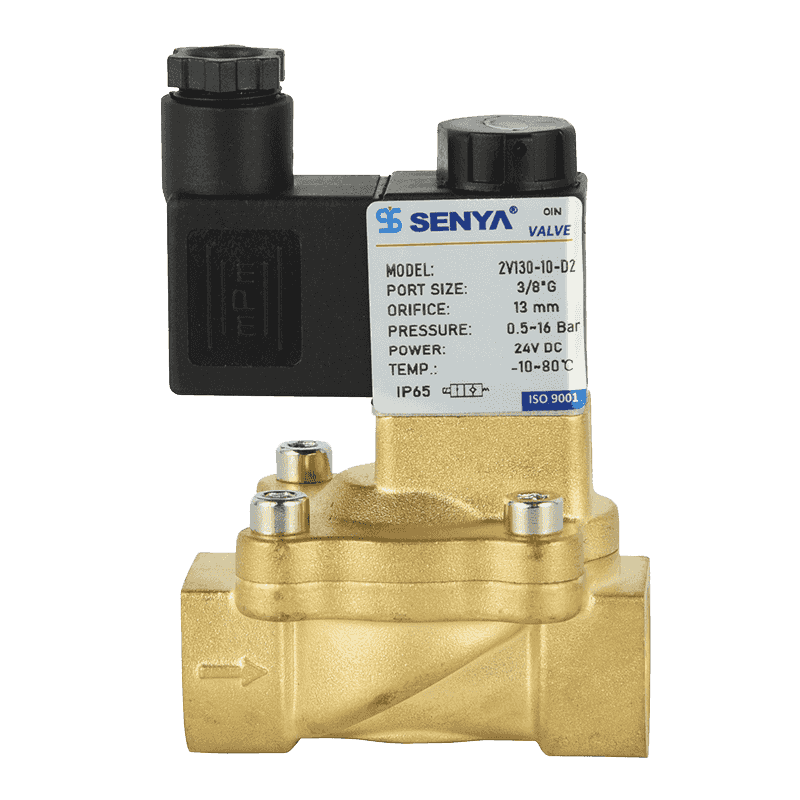
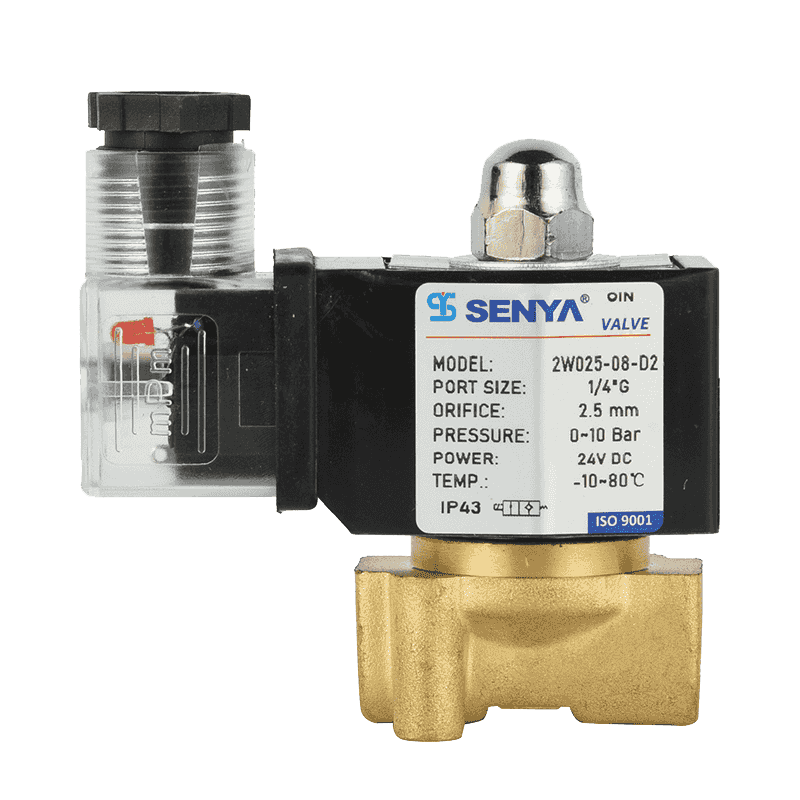
| Brass | Compressed air, cold water, neutral gas | Moderate corrosion resistance, up to roughly 16 bar on small ports | Lowest cost for general duty; dezincification is a risk in aggressive or chlorinated water |
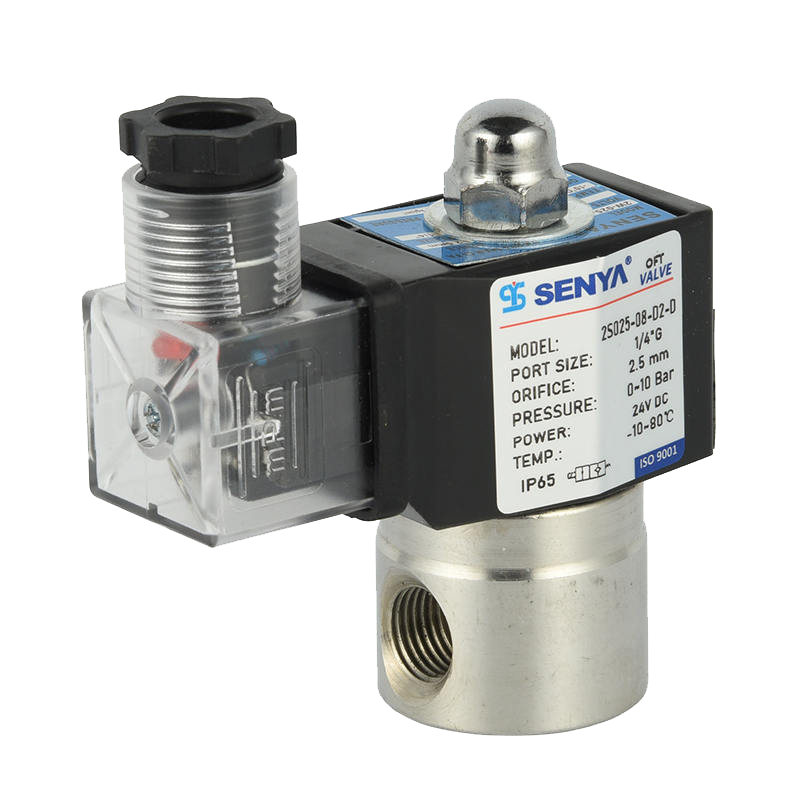
| SUS304 stainless steel | Water, mildly corrosive media, washdown areas | High corrosion resistance, similar pressure range to brass | Longer life where condensation is constant; higher unit cost |
| Cast aluminium | Air and inert gas only | Low corrosion resistance, medium pressure capability | Common on larger pilot and pulse valves; requires dry air |
| Plastic (PA or POM) | Air and light-duty water | High chemical resistance, low pressure capability | Economical on compact manifolds; sensitive to UV, heat and mechanical stress |
Seal compound is the other half of the decision. Nitrile (NBR) covers air, water and neutral media up to about 80 degrees Celsius. EPDM suits hot water and steam-adjacent duty. FKM handles oils, fuels and higher temperatures, and PTFE is the fallback where chemical resistance dominates. A seal that swells in the wrong medium jams the pilot orifice, which is one of the most common causes of a valve that simply stops working.
 2W Series Brass Water Solenoid Valve for High-Impurity LinesDirect-acting 2/2-way brass water valve with high impurity tolerance, zero differential pressure start, large-flow anti-blockage body, and configurable seals for varied media.View Product →
Air Quality and the Working Environment
An air solenoid is a precision mechanism sitting at the end of a distribution system. Water carryover, compressor oil, rust and pipe scale all collect on the plunger and the seal face, and the resulting failures are almost always blamed on the valve.
ISO 8573-1 defines compressed air purity by particle, water and oil content, and equipment specifications increasingly reference it. In practice, three rules cover most installations:
- Dry the air before it reaches the valve. A refrigerated dryer plus a properly drained receiver removes more water than any filter downstream can compensate for.
- Filter at the point of use. A 5 micron element with an automatic drain handles most contamination; add a coalescing stage where oil aerosol is present, and remember that a saturated element is worse than no filter because it releases what it has collected.
- Regulate close to the valve. Long, undersized lines drop pressure under flow, and a pilot-operated valve that needs 0.3 bar of differential can starve during the cylinder's peak demand.
 AEC Series Filter Regulator Lubricator Combination UnitCompact FRL unit combining filtration, pressure regulation, and lubrication for compressed air systems, with 40 µm filtration, optional finer elements, and 0–1.0 MPa range.View Product →
The environment outside the coil matters too. Washdown bays, outdoor irrigation and dust-collector installations call for IP65 enclosures and DIN connectors with a proper gasket; a standard open coil will not survive a hose-down for long. Where the valve sits on a moving carriage or a wet floor, a waterproof design costs less than the stoppage it prevents.
 Submerged Brass Solenoid Valve for Music Fountain Water Columns2/2-way brass solenoid valve designed for submerged music fountain water columns, with sealed waterproof coil, IP6X protection, and fast switching response.View Product →
A Practical Selection Checklist
- Define the medium, its temperature range and its cleanliness first. Air, water, light oil and inert gas lead to different body and seal choices.
- Convert the required flow into Cv or Kv at your working pressure, then pick a valve with margin. Do not size from the pipe thread.
- Confirm the actuation principle against the pressure available at start-up, not only at steady state.
- Check the electrical side: voltage, AC or DC, inrush current, duty cycle and connector standard.
- Match the seal compound to the medium and temperature, then verify it against the supplier's chemical compatibility chart.
- Confirm the enclosure rating and ambient temperature for the installation, and plan the maintenance interval for filters and drains.
If you want the sizing arithmetic and port configurations worked through in more detail, this guide on choosing the right 2/2-way solenoid valve extends the checklist with practical examples.
Where These Valves Actually Fail
Field failures cluster into a small number of patterns. Working backwards from the symptom usually identifies the real problem faster than replacing parts.
| Symptom | Most likely cause | First check |
|---|---|---|
| Coil burns out or trips the breaker | Stuck plunger holding inrush current, over-voltage, or a short-duty coil held energised | Measure voltage under load and check plunger travel by hand |
| Valve will not close | Contamination on the seat or a swollen seal | Inspect the seal and pilot orifice for foreign material |
| Slow or weak response | Partly blocked pilot orifice or a swollen elastomer | Clean the orifice and re-check seal compatibility |
| Continuous leakage at the outlet | Scale or dried medium on the sealing face | Flush the valve and review filtration upstream |
| Repeated diaphragm or piston failure | Pressure spikes above the rated maximum, or water hammer | Fit a regulator or soft-start valve upstream |
Buying Considerations
Consistency between units matters more than any single specification. A production line running fifty identical valves wants fifty valves that switch within the same few milliseconds, hold the same seat pressure and share the same spare seal kit. Ningbo SENYA Pneumatic Technology has manufactured pneumatic valves, cylinders, air treatment units and push-in fittings since 1994, exports to more than 30 countries and integrates its own precision machining plant, which is the point at which batch-to-batch consistency is decided. More on the company's production base and testing equipment is available in the company background.
Frequently Asked Questions About Air Solenoid Valves
Q1. What is an air solenoid valve used for?
It switches compressed air on and off, or redirects it, in response to an electrical signal. Typical duties include driving cylinders on packaging and assembly machines, piloting larger valves, and controlling water or gas lines in irrigation, dust collection and food processing equipment.
Q2. What size air solenoid valve do I need?
Size on flow, not on pipe thread. Convert the required flow into Cv or Kv at your working pressure, then choose a valve with roughly 20 to 30 percent margin. A half-inch valve with a small orifice can deliver less flow than a three-eighths valve with a larger one.
Q3. What is the difference between NC and NO solenoid valves?
Normally closed valves block flow until the coil is energised; normally open valves pass flow until energised. Choose NC when you want a safe stop if power is lost, and NO when the process must keep running during a power failure.
Q4. Can I use a 12V or 24V air solenoid valve?
Yes, both are standard, and DC coils are common on mobile and battery-backed equipment. Check the holding current, the voltage tolerance and whether the valve needs full line pressure to switch before committing to a low-voltage DC coil.
Q5. Why does my pneumatic solenoid valve keep failing?
Coil burnout, sticking plungers and seat leakage usually trace back to three things: wet or dirty compressed air, a coil energised beyond its duty cycle, and a seal compound that swells in the medium. Fix the air quality and the electrical supply before replacing the valve again.
Q6. Is a brass or stainless steel solenoid valve better for water?
Brass is the economical choice for clean, cold water. SUS304 stainless steel lasts longer where water is chlorinated, slightly acidic or constantly condensing, and it is the safer option for washdown areas and food-adjacent equipment.