
 简体中文
简体中文 English
 Русский
Selecting the right solenoid valve for ink flow usually comes down to three things: what the ink touches, how much pressure is available, and how fast the valve can respond. If you get those three right, most of the other decisions—voltage, connection, and coil rating—are straightforward. In this guide, you will find the selection criteria that actually cause failures in printing systems, along with a checklist you can use before placing an order.
Content
- 1 Why Ink Flow Is Different from Air or Water
- 2 Start with Material Compatibility
- 3 Match Flow and Pressure Ratings to Your Nozzle System
- 4 Response Time and Duty Cycle
- 5 Construction: Direct-Acting, Pilot-Operated, and Dead Volume
- 6 Maintenance Considerations for Ink Systems
- 7 Selection Checklist
- 8 Frequently Asked Questions
Why Ink Flow Is Different from Air or Water
Ink is not a clean, low-viscosity fluid. Water-based inks contain surfactants and pH adjusters; solvent-based inks contain ketones and alcohols that can attack ordinary elastomers; UV-curable inks contain photoinitiators that leave residue and can swell seals. A solenoid valve designed for compressed air may run for years on an air line, then fail in weeks on ink because the seal material degrades, the orifice becomes blocked, or the plunger sticks. The Lee Company points out that in printers a solenoid valve can be used to dispense droplets of ink, and the inlet pressure must remain constant to keep the droplets consistent. That pressure constancy depends on the valve's ability to open and close without cavitation or leakage.
Start with Material Compatibility
The first question is not voltage—it is fluid compatibility. For water-based inks, brass and stainless steel are common choices. For solvent-based inks, stainless steel is safer because it resists chemical attack. For UV inks, choose stainless steel or a PTFE-coated body to prevent residue from bonding to the seat. Avoid plastic valves with aggressive solvents; they can stress-crack after repeated exposure. The table below summarizes the basic recommendations.
| Ink type | Typical carrier | Recommended body | Watch out for |
|---|---|---|---|
| Water-based | Water, glycol | Brass, 304 stainless | Rust on untreated iron |
| Solvent-based | Ketones, alcohols | 304/316 stainless | Elastomer swelling |
| UV-curable | Acrylate monomers | Stainless or PTFE | Photoinitiator residue |
 Direct-acting 2/2-way stainless steel solenoid valve for acid and alkali mediaThis normally closed valve features SUS304 body and Viton seals, suitable for harsh chemical environments. It operates at zero pressure differential and responds within 20-25 ms, making it reliable for low-pressure ink systems where pilot-operated valves may fail.View Product →
Match Flow and Pressure Ratings to Your Nozzle System
After material compatibility, the biggest error is ignoring the valve's minimum operating pressure differential. A pilot-operated solenoid valve needs a certain pressure difference across the seat to open reliably. If your ink supply is low-pressure, it may never open fully, causing starvation. A direct-acting valve can open at zero differential but has a smaller orifice. You must match the flow coefficient (Cv) to the maximum demanded flow. A useful rule is to size the valve so the pressure drop at the required flow rate is no more than 10% of the supply pressure. For a small 2 mm orifice, the flow capacity will be roughly one quarter of a 4 mm orifice at the same differential pressure. If your ink system uses a diaphragm pump with pulsating pressure, add a small accumulator before the valve to keep the inlet pressure stable.
Stainless steel and brass bodies also differ in their surface roughness, which affects how easily pigment deposits stick. A polished stainless bore can reduce clogging compared to a cast brass bore. For higher flow applications, consider a large water-control valve with high impurity tolerance, but verify that the spring force still resets the plunger under your maximum flow. For a deeper dive into this area, see our detailed selection guide for 2/2-way solenoid valves.
Response Time and Duty Cycle
Printheads firing hundreds of times per second need a valve that opens and closes faster than the ink delivery cycle. Direct-acting solenoid valves typically respond in 5–20 ms; pilot-operated valves are slower, often 20–80 ms, because they must fill a pilot chamber first. The duty cycle is equally important. If the valve is energized for long periods, the coil temperature rises, which reduces pulling force. Choose a coil rated for 100% duty cycle if the valve will stay open for extended times. The chart below shows typical response windows for the two common constructions.
Construction: Direct-Acting, Pilot-Operated, and Dead Volume
Direct-acting valves are simpler and can operate at zero pressure differential, making them safe for low-pressure ink reservoirs. Pilot-operated valves handle larger flow rates but require a minimum differential. In ink systems, the pilot passage can become clogged by pigment agglomerates if the valve is not cleaned periodically. Another factor is dead volume—the internal volume that remains filled with ink when the valve closes. Larger dead volume means more solvent is wasted during purge cycles and a higher risk of drying at the nozzle. The diagram below labels the key parts of a typical diaphragm-type 2/2-way solenoid valve.
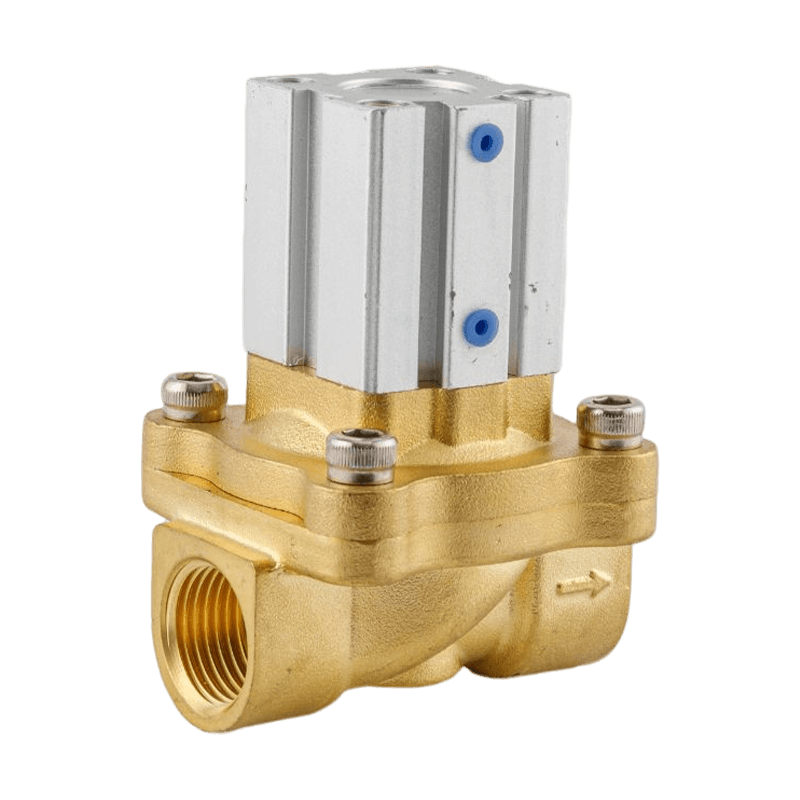 Pneumatically operated control valve for safe large-flow fluid handlingThis air-controlled valve offers large flow capacity and is ideal for flammable or explosive environments where electrical solenoids pose risks. It supports various seals for temperatures up to 180°C and provides a compact, easy-to-maintain design.View Product →
Maintenance Considerations for Ink Systems
Even the best valve will need periodic flushing. Install a filter upstream to catch agglomerated pigment before it reaches the seat. Select seals that tolerate the ink's solvent; EPDM is common for water-based inks, FKM is better for solvent-based inks. If the valve body is not explosion-rated, do not use it around solvent-based inks without ventilation. A common practice is to run a short flush cycle between color changes. In continuous inkjet systems, check valve response after every 10 million cycles; a worn spring or eroded seat will change the flow profile and cause drop misplacement.
Manufacturers with in-house precision machining can control bore concentricity, which directly affects how evenly the plunger seats. Our production background is built around this kind of tolerance control, and it is one reason we can provide consistent performance for demanding ink applications.
Selection Checklist
- Identify the exact ink chemistry (water, solvent, UV).
- List the minimum and maximum supply pressure at the valve.
- Calculate the required Cv from your nozzle flow demand.
- Choose direct-acting if inlet pressure can drop to nearly zero.
- Choose pilot-operated only if a stable differential is available.
- Confirm the coil voltage and duty cycle rating.
- Select seal material based on solvent compatibility.
- Plan an upstream filter and a flush procedure.
- Check IP and certification requirements for your environment.
- Request a sample test with the actual ink before mass production.
Frequently Asked Questions
What solenoid valve should I use for ink flow?
Use a direct-acting 2/2-way valve with stainless steel wetted parts and a fast coil.
What is an industrial solenoid valve?
It is an electrically operated valve that controls liquid or gas flow in industrial systems using a coil to move a plunger.
How do I choose a solenoid valve for printing?
Match ink compatibility, pressure differential, flow coefficient, and response time to your printhead.
What is the difference between normally closed and normally open?
Normally closed blocks flow without power; normally open passes flow without power. For ink, normally closed prevents drips.
Can a solenoid valve handle solvent-based ink?
Yes, if the body and seals are selected for solvent resistance, typically 304/316 stainless with FKM seals.
How often should I flush the valve?
Flush after every color change, and at least once per shift if the machine runs continuously.
.png?imageView2/2/w/326/h/326/format/jpg/q/75)
.png?imageView2/2/w/326/h/326/format/jpg/q/75)
.png?imageView2/2/w/326/h/326/format/jpg/q/75)
.png?imageView2/2/w/326/h/326/format/jpg/q/75)
.png?imageView2/2/w/326/h/326/format/jpg/q/75)