
 简体中文
简体中文 English
 Русский
A 2/2 way solenoid valve is an electromechanically operated valve with two ports and two positions — open and closed. When electrical current is applied to the solenoid coil, it generates a magnetic field that moves a plunger, opening or closing the flow path between the inlet and outlet ports. This simple yet powerful mechanism makes the 2/2 way solenoid valve one of the most widely used components in fluid and gas control systems worldwide, spanning industries from agriculture to pharmaceuticals.
Whether you need a normally closed solenoid valve that blocks flow until energized, or a normally open solenoid valve that allows flow until energized, the 2/2 configuration delivers precise on/off control with fast response times and minimal maintenance requirements. Understanding its design, selection criteria, and applications helps engineers and procurement specialists make informed decisions for their specific systems.
Content
- 1 How Does a 2/2 Way Solenoid Valve Work?
- 2 Main Types of 2/2 Way Solenoid Valves
- 3 Performance Specifications at a Glance
- 4 Common Applications of Water Solenoid Valves
- 5 How to Choose the Right 2/2 Way Solenoid Valve
- 6 Voltage Options for Solenoid Valves: Which Is Best for Your System?
- 7 About SENYA: Your Trusted Solenoid Valve Manufacturer
- 8 Advantages of Using a Solenoid Valve in Automated Systems
- 9 Installation and Maintenance Best Practices
- 10 Frequently Asked Questions
Water treatment and industrial automation together account for over half of all solenoid valve deployments globally. Agricultural irrigation ranks third, reflecting the growing adoption of automated water solenoid valves in precision farming. The medical and pharmaceutical sectors represent the fastest-growing segment due to stricter hygiene requirements and increased automation in sterilization processes.
How Does a 2/2 Way Solenoid Valve Work?
The operating principle of a 2/2 way solenoid valve relies on electromagnetic force. The valve body houses two key components: a solenoid coil and a movable ferromagnetic plunger or armature. When DC or AC voltage is applied, the coil produces a magnetic flux that pulls the plunger toward the core, compressing a return spring and either opening or closing the orifice between the two ports.
Two primary actuation modes exist: direct-acting and pilot-operated. Direct-acting valves use the solenoid force alone to move the main seal, making them suitable for low-pressure or zero-differential-pressure applications. Pilot-operated solenoid valves use the line pressure itself as a servo force — the solenoid opens a small pilot orifice, and the resulting pressure differential moves the main diaphragm or piston. This design allows relatively small coils to control high-flow, high-pressure lines efficiently.
Response times typically range from 20 to 100 milliseconds for direct-acting models and 50 to 300 milliseconds for pilot-operated versions, depending on coil wattage, fluid viscosity, and pressure differential. This rapid switching capability is a core advantage over manual or pneumatic valve alternatives in automated systems.
Normally Closed vs. Normally Open: Key Differences
| Parameter | Normally Closed (NC) | Normally Open (NO) |
|---|---|---|
| Default State | Flow blocked | Flow allowed |
| Energized State | Flow allowed | Flow blocked |
| Energy Consumption | Only when open | Only when closed |
| Fail-safe Behavior | Closes on power loss | Opens on power loss |
| Typical Use | Water supply, dosing systems | Cooling circuits, safety venting |
Main Types of 2/2 Way Solenoid Valves
The market offers a broad range of 2/2 way solenoid valve designs, each optimized for different media, pressures, and environmental conditions. Choosing the correct type directly affects system reliability, service life, and total cost of ownership.
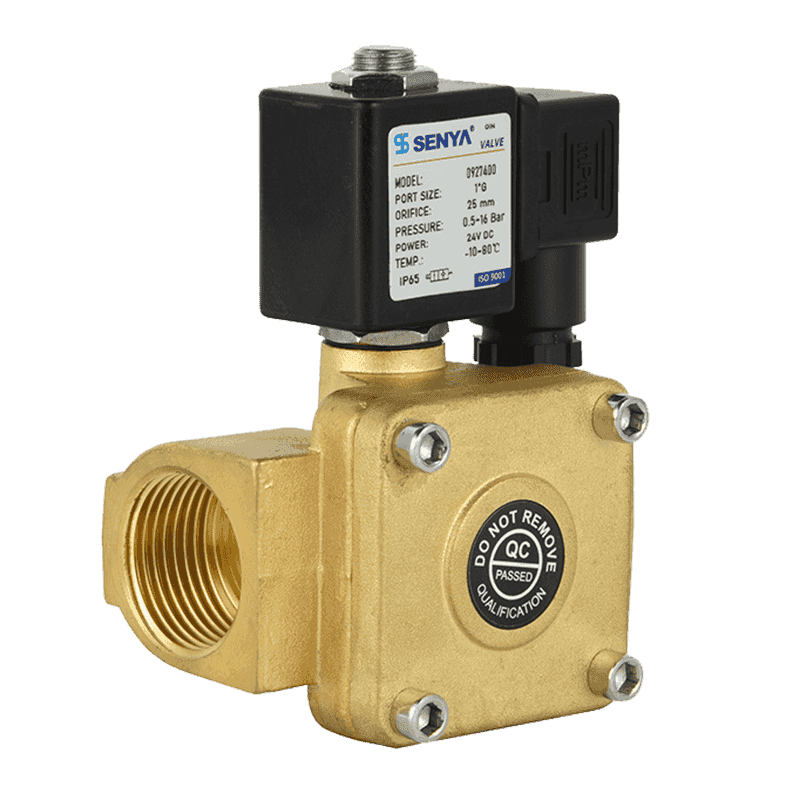
- Brass Water Solenoid Valve: The most common choice for water, air, and light oil applications. Brass offers excellent corrosion resistance against tap water and mild chemicals, good machinability, and cost efficiency. Suitable for pressures up to 16 bar in typical water supply systems.
- Stainless Steel Solenoid Valve: Preferred for aggressive media such as seawater, acidic solutions, food-grade fluids, and steam. High corrosion-resistant stainless steel bodies maintain structural integrity across a wide temperature range (-40°C to +180°C for certain grades) and meet hygienic standards for food and pharmaceutical sectors.
- Plastic Body Solenoid Valve: Lightweight and chemically resistant to specific acids and bases. Used in laboratory, pool treatment, and chemical dosing systems where metal contamination must be avoided.
- Pilot Operated Solenoid Valve: Designed for high-flow industrial lines. The pilot mechanism allows a low-power coil (typically 3–10 W) to control orifices from DN15 up to DN100 or larger, making it the preferred design for industrial water solenoid valve applications requiring high Kv flow factors.
- Zero-Differential Pressure / Bistable Valve: Opens and closes regardless of inlet/outlet pressure difference. Critical for systems where back pressure or vacuum conditions exist, such as solar heating, sprinkler systems, and low-head irrigation loops.
Performance Specifications at a Glance
Understanding the core specifications of a 2/2 way solenoid valve is essential before specifying or purchasing. The chart below compares typical performance parameters across the most common body materials and valve sizes encountered in industrial and commercial applications.
Maximum Operating Pressure by Valve Material (bar)
Stainless steel and pilot-operated solenoid valves handle the highest operating pressures, making them the preferred choice for demanding industrial water solenoid valve installations. Brass valves offer reliable performance up to 16 bar for standard water and compressed air applications. Plastic-body valves are limited to lower pressure ranges but provide superior chemical inertness. Always verify the valve's rated pressure against your system's maximum working pressure and any anticipated pressure surges.
Common Applications of Water Solenoid Valves
The water solenoid valve finds application wherever automated, remote, or rapid fluid control is needed. The 2/2 way design is especially versatile because its binary operation integrates cleanly into PLCs, microcontrollers, and timer-based control circuits without complex programming logic.
- Car Wash Systems: High-cycle normally closed solenoid valves control soap, rinse, and wax water flows. Typical duty cycles exceed 500,000 operations per year, demanding robust seals and corrosion-resistant bodies.
- Agricultural Irrigation: Battery-powered or solar-powered 24V DC water solenoid valves automate drip and sprinkler irrigation zones, enabling precise water delivery and significant conservation — studies show automated irrigation reduces water use by 20–50% compared to manual scheduling.
- Medical Sterilizing Equipment: Stainless steel solenoid valves control steam and disinfectant flows in autoclaves and surgical instrument washers, where materials must meet FDA and CE hygiene standards.
- Music Fountains: Arrays of fast-acting solenoid valves synchronized by a control system create choreographed water effects. Response times under 50 ms are critical to match musical beat patterns.
- Mining and Dust Suppression: Pilot-operated solenoid valves handle the high-pressure, high-flow demands of dust suppression mist systems, working reliably in harsh, dusty environments with IP65 or IP67 enclosure ratings.
- Food Processing: Hygienic stainless steel solenoid valves with EPDM or PTFE seals control CIP (Clean-In-Place) processes, hot water dosing, and ingredient delivery where contamination risk must be zero.
- Solar Heating Systems: Zero-differential-pressure solenoid valves manage glycol and water flows in solar collectors, operating correctly even when circulation pumps generate minimal head pressure.
Global Solenoid Valve Market Growth (USD Billion, 2019–2027E)
The global solenoid valve market has expanded consistently since 2019, driven by accelerating industrial automation, smart irrigation adoption, and water infrastructure upgrades. Projected to exceed USD 4 billion by 2027, the market's compound annual growth rate reflects robust demand for both brass water solenoid valves and high-specification stainless steel variants. Emerging economies in Southeast Asia, Africa, and South America are contributing significantly to this growth through large-scale infrastructure and agriculture projects.
How to Choose the Right 2/2 Way Solenoid Valve
Selecting the correct solenoid valve involves evaluating multiple interdependent parameters. A mismatch in even one specification — such as seal material or pressure rating — can lead to premature failure, leakage, or unsafe system behavior. The following structured approach ensures the right valve is specified the first time.
Step 1: Define the Media
Identify the fluid or gas flowing through the valve. Water and compressed air are compatible with standard brass bodies and NBR seals. Aggressive chemicals, seawater, or steam require stainless steel solenoid valve bodies and EPDM, PTFE, or FKM seal materials. Always check the valve manufacturer's chemical compatibility chart before finalizing material selection.
Step 2: Determine Pressure and Flow Requirements
Specify the minimum and maximum operating pressure (MOP), and calculate the required flow coefficient (Kv or Cv). The Kv value describes the flow rate in m³/h of water through the valve at a 1 bar pressure drop. A pilot-operated solenoid valve requires a minimum differential pressure — typically 0.3 to 0.5 bar — to function correctly, while direct-acting valves work from zero differential pressure up to their rated maximum.
Step 3: Select Voltage and Power Supply
Solenoid valves are available in a wide range of voltages. Common options include 24V DC (the most popular in modern PLC systems and solar-powered applications), 12V DC (battery and mobile systems), 110V AC, and 220/230V AC (direct mains connection). DC coils offer lower power consumption and generate less heat; AC coils are simpler to connect to mains supplies. For remote or off-grid locations such as field irrigation or mining sites, 24V DC water solenoid valves paired with solar panels represent the most practical solution.
Step 4: Check Temperature Range and Ingress Protection
Ambient and media temperatures directly affect seal life and coil performance. Standard coils are rated for ambient temperatures up to 50°C–55°C; high-temperature versions handle up to 90°C ambient. Outdoor or washdown environments require at minimum an IP65 coil enclosure rating to prevent moisture ingress. Submerged or high-pressure-wash environments demand IP67 or IP68 ratings.
Radar Comparison: Brass vs Stainless Steel Solenoid Valve
The radar chart clearly illustrates that stainless steel solenoid valves outperform brass in corrosion resistance, pressure rating, temperature range, and hygiene rating — critical factors for food, medical, and chemical applications. Brass excels in cost efficiency and delivers strong cycle life performance, making it the preferred choice for high-volume, budget-conscious water supply and irrigation projects. For mixed-media or multi-application facilities, stainless steel represents a longer-term investment with lower lifetime maintenance costs.
Voltage Options for Solenoid Valves: Which Is Best for Your System?
Voltage selection affects safety, compatibility with existing control infrastructure, and operational costs. The table below summarizes the most common voltage options and their ideal use cases to simplify your decision.
| Voltage | Type | Typical Power (W) | Best For |
|---|---|---|---|
| 12V DC | DC | 3–8 W | Battery systems, automotive, small robots |
| 24V DC | DC | 3–10 W | PLC systems, solar irrigation, industrial automation |
| 110V AC | AC | 8–20 W | North American mains-connected systems |
| 220/230V AC | AC | 8–20 W | European/Asian mains-connected industrial systems |
Among all available options, 24V DC has become the industry standard for new automation installations. It falls within the SELV (Safety Extra Low Voltage) threshold, reducing electrical hazard risk for maintenance personnel, and interfaces directly with most PLC output cards and IoT controllers without requiring additional relays or transformers. For high-duty-cycle applications, latching solenoid valves — which consume power only during switching, not while held open or closed — reduce continuous power draw to near zero.
About SENYA: Your Trusted Solenoid Valve Manufacturer
Ningbo SENYA Pneumatic Technology Co., Ltd. has been a specialized solenoid valve manufacturer and pneumatic component producer since 1994. Focused on the principle of "Customer Value Implementation," SENYA operates as both a precision machinery processing plant and an R&D organization, serving mid-to-high-end industrial markets across more than 30 countries including the United States, Turkey, Spain, Italy, Britain, South Korea, Australia, and Mexico.
As a professional China 2/2 way solenoid valve manufacturer and water solenoid valve factory, SENYA's production capabilities exceed 2,000,000 sets of pneumatic components annually, encompassing cylinders, valves, and related products. The facility employs advanced high-concentricity machining and a precision automatic digital testing platform that ensures product consistency and stability from batch to batch — a critical requirement for clients in regulated industries such as medical sterilization, food processing, and automated manufacturing.
SENYA's product applications span car washing, medical sterilizing equipment, automated production lines, mining and dust removal, music fountains, agricultural irrigation, solar projects, agricultural machinery, and food processing. The company also prioritizes environmental responsibility, actively promoting green product designs that reduce energy consumption and greenhouse gas emissions throughout the product lifecycle.
SENYA Export Markets — Indicative Regional Distribution (%)
SENYA's export network spans over 30 countries across five continents, with the Americas and Europe collectively representing nearly 60% of export volume. This broad geographic footprint reflects the cross-sector versatility of SENYA's valve product lines — from industrial water solenoid valves serving US manufacturing plants to compact brass valves for European agricultural machinery. Asia-Pacific demand continues to grow alongside regional infrastructure investment.
Advantages of Using a Solenoid Valve in Automated Systems
The 2/2 way solenoid valve has replaced manual and pneumatically-actuated valves in a wide range of automated systems for compelling technical and economic reasons. Understanding these advantages helps justify the investment and ensures system designers leverage the technology correctly.
- Fast Response: Switching times between 20 and 300 ms enable precise dosing, rapid sequencing, and synchronization with high-speed production processes that manual valves cannot match.
- Remote Operation: Electrical control enables integration with SCADA systems, PLCs, IoT platforms, and mobile apps, allowing operators to control dozens of valves from a single interface without being physically present at each valve location.
- Compact Design: Solenoid valves have a much smaller footprint than motorized ball valves or pneumatic cylinder-actuated valves for the same flow capacity, reducing installation space and weight in panel boards and skid-mounted systems.
- Long Service Life: With proper sizing and seal selection, high-quality solenoid valves achieve 5 to 10 million switching cycles before seal replacement, translating to decades of service in low-to-medium-duty applications.
- Energy Efficiency: Modern DC solenoid valves with pulse-width modulation (PWM) or latching technology consume as little as 1–3 W in the holding state, compared to 10–20 W for older AC designs. Over thousands of valves in a large industrial plant, this difference translates to substantial energy savings.
- Cost-Effective Automation: Low unit costs combined with long service life make solenoid valves one of the most economical actuators available for on/off fluid control in systems requiring anywhere from a handful to thousands of control points.
Installation and Maintenance Best Practices
Correct installation is as important as correct selection. Even the highest-quality solenoid valve will underperform or fail prematurely if installed incorrectly. The following guidelines apply to the majority of 2/2 way solenoid valve installations in water and fluid systems.
- Observe Flow Direction: Most solenoid valves are unidirectional. Install with the inlet port matched to the upstream pressure source as indicated by the arrow on the valve body. Reversed installation can cause the valve to fail to open or to leak under pressure.
- Install a Strainer Upstream: Particle contamination is the leading cause of solenoid valve seal failure. A 100–200 mesh strainer (80–150 micron) installed immediately upstream protects the orifice and seal from debris. Clean or replace the strainer at regular intervals.
- Mount the Coil Upright or Horizontally: Coils should ideally be mounted with the coil housing facing upward or horizontal to prevent condensation from pooling inside the electrical connection area. Avoid mounting the coil facing downward in wet environments unless the valve carries an appropriate IP rating for that orientation.
- Use Appropriate Sealants: Apply PTFE tape or thread sealant compound to NPT or BSP threads. Do not over-tighten — brass bodies are particularly susceptible to cracking if overtorqued. Follow the manufacturer's recommended torque values.
- Periodic Seal Inspection: In high-cycle applications, inspect and replace seals at the manufacturer's recommended intervals — typically every 2–5 million cycles for NBR seals and every 5–10 million for PTFE-coated seals. Maintaining a small stock of OEM seal kits minimizes downtime during scheduled maintenance.
Frequently Asked Questions
Q1: How does a solenoid valve work?
When electrical current passes through the coil, it generates a magnetic field that moves a plunger to open or close the valve orifice. Removing the current allows a spring to return the plunger to its default position, giving the valve its normally open or normally closed characteristic.
Q2: What is a 2/2 way solenoid valve?
A 2/2 way solenoid valve has two ports (one inlet, one outlet) and two switching positions (open and closed). It is the simplest solenoid valve configuration, used wherever a straightforward on/off control of a fluid or gas flow is required without any diversion or mixing of media.
Q3: What is a water solenoid valve used for?
Water solenoid valves are used to automate water flow control in irrigation systems, car washes, water treatment plants, household appliances (dishwashers, washing machines), medical equipment, and industrial cooling circuits. They can be remotely controlled or timer-driven to open and close water supply without manual intervention.
Q4: What are the advantages of solenoid valves?
Key advantages include fast switching response, remote electrical control, compact size, long service life, low maintenance requirements, and straightforward integration with PLC and IoT control systems. Their energy efficiency and low unit cost make them a practical choice for both small-scale and large-scale fluid automation projects.
Q5: How do I choose the right solenoid valve?
Start by identifying your media type, operating pressure range, required flow rate (Kv value), available voltage supply, ambient temperature, and environmental IP requirements. Matching all these parameters to the valve specification sheet ensures correct selection. When in doubt, consult the manufacturer's selection guide or technical support team.
Q6: Which voltage is best for a solenoid valve?
24V DC is widely regarded as the best all-around choice for modern automation systems. It meets SELV safety standards, interfaces directly with most PLCs and IoT controllers, operates efficiently on solar power, and generates less heat than AC coils. For direct mains connection in Europe, 230V AC is standard; in North America, 110V AC is common.
Q7: Should I choose brass or stainless steel?
Choose a brass water solenoid valve for standard water, air, or light oil applications where cost efficiency matters and the media is not particularly aggressive. Choose a stainless steel solenoid valve when handling corrosive fluids, steam, seawater, food-grade media, or when hygiene certifications are required. Stainless steel also performs better in harsh outdoor or coastal environments.
Q8: What pressure can a solenoid valve handle?
Standard brass solenoid valves typically handle up to 16 bar. Stainless steel and pilot-operated models can be rated for 25 bar or higher depending on design. Always verify that the valve's maximum operating pressure (MOP) exceeds the highest system pressure including any water hammer or surge events, as transient pressure spikes can exceed steady-state values by 50–100%.
.png?imageView2/2/w/326/h/326/format/jpg/q/75)
.png?imageView2/2/w/326/h/326/format/jpg/q/75)
.png?imageView2/2/w/326/h/326/format/jpg/q/75)
.png?imageView2/2/w/326/h/326/format/jpg/q/75)
.png?imageView2/2/w/326/h/326/format/jpg/q/75)