
 简体中文
简体中文 English
 Русский
When a packaging line starts dropping strokes, or a car-wash boom jerks at the end of its travel, the cylinder usually takes the blame. Most of the time the cylinder is fine - the specification was wrong. An air cylinder is a simple device: a bore, a piston, a rod and a set of seals. Nearly every performance complaint traces back to three numbers that should have been calculated before the purchase order was signed: the force the load actually needs, the stroke the mechanism actually travels, and the air the circuit will actually consume.
The short answer: size the bore from the force required at the lowest working pressure your plant reliably delivers, add a 25-30% margin, match the stroke to the mechanical travel plus a cushioning allowance, and check the resulting air consumption against compressor capacity. Mounting style, seal material, cushioning and magnetic sensing are consequences of those three decisions, not the starting point.
Content
Bore, Stroke and Force: The Numbers to Fix First
A pneumatic cylinder turns pressure into linear force. Theoretical extend force is gauge pressure multiplied by piston area. Retract force is lower because the rod occupies part of the piston face: a 63 mm bore at 0.6 MPa produces roughly 1,870 N extending, but about 1,680 N retracting with a 20 mm rod. That difference is negligible in a simple clamp and significant in a press where both directions do real work.
Real force is lower than theory. Rod and piston seal friction, plus the return spring in single-acting designs, typically consumes 10-15%. The bore should therefore be selected against the lowest pressure the plant actually delivers at the machine, not the nameplate pressure at the compressor.
| Bore (mm) | Piston area (mm2) | 0.5 MPa | 0.6 MPa | 0.7 MPa |
|---|---|---|---|---|
| 32 | 804 | 402 N | 483 N | 563 N |
| 40 | 1,257 | 628 N | 754 N | 880 N |
| 50 | 1,963 | 982 N | 1,178 N | 1,374 N |
| 63 | 3,117 | 1,559 N | 1,870 N | 2,182 N |
| 80 | 5,027 | 2,513 N | 3,016 N | 3,519 N |
| 100 | 7,854 | 3,927 N | 4,712 N | 5,498 N |
Stroke is often treated as a measurement rather than an engineering decision. Two habits prevent most problems: leave enough stroke that the piston never bottoms out against the end cap, and keep a few millimetres of cushioning travel at each end so the adjustable cushion decelerates the load instead of the end cap absorbing the impact.
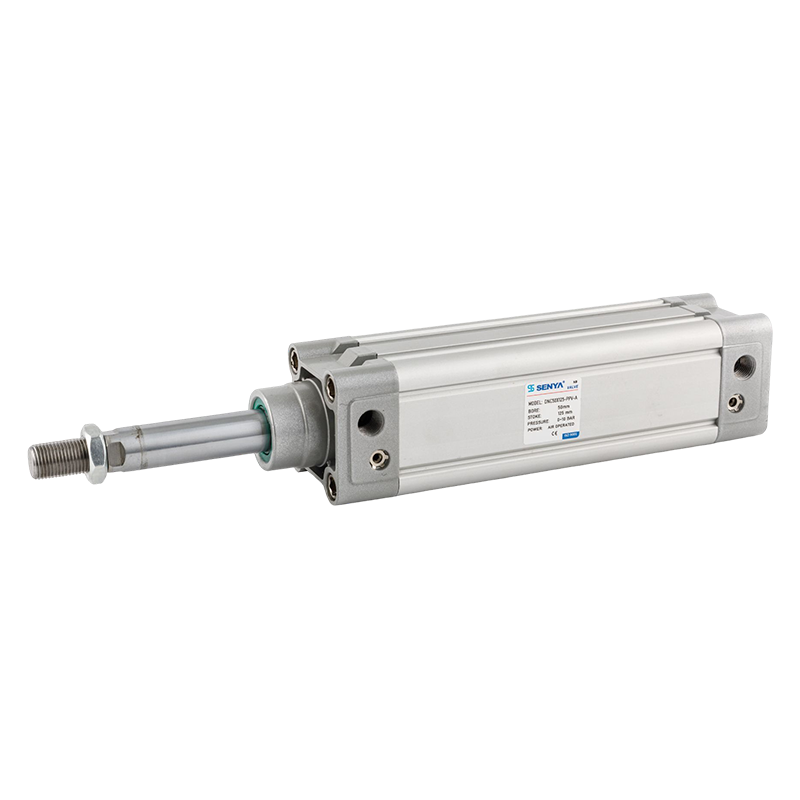 ISO15552 pneumatic cylinder SuppliersDNC series ISO 15552 standard air cylinder Pneumatic actuator for fast and flexible lubricationView Product →
Which Cylinder Type Fits the Machine
Three families cover most industrial applications. The choice is normally driven by mounting space, guidance requirements and how the cylinder interfaces with the rest of the machine.
ISO 15552 profile cylinders
ISO 15552 standardises mounting dimensions, port positions and rod threads for bores from 32 mm upward, so a cylinder from one manufacturer can replace another without redrilling brackets. That interchangeability is why the standard dominates packaging, assembly and material-handling machines. The extruded barrel also accepts magnetic switches anywhere along the stroke, which simplifies position feedback.
SC series rod cylinders
SC cylinders use a tie-rod body with bolted end caps, a construction that has been a workhorse in general automation for decades. They suit fixtures, gates and straightforward push-pull duties where a robust cylinder with a familiar footprint matters more than an extruded profile. Because the end caps are bolted rather than rolled, seals can be accessed for repair instead of scrapping the whole unit.
 Tie rod type air cylinder Pneumatic actuator for fast and flexible lubricationChrome plated piston rod wear resistance, high rigidityView Product →
MAL and mini cylinders
Mini cylinders bring the same operating principle into tight spaces: part ejection, small clamps, shutter and diverter gates, and pick-and-place heads. Bores in the 16-25 mm range are usually sufficient, and the low air consumption matters when a single machine carries dozens of them.
 An automated cylinder that replaces manual simulation of mechanical outputChrome plated piston rod wear resistance, high rigidityView Product →
What an Air Cylinder Costs to Run
Force is a one-time calculation. Air consumption is a running cost that repeats every cycle. Free-air volume per stroke is piston area multiplied by stroke and the absolute pressure ratio; at 0.6 MPa gauge (7 bar absolute) a 100 mm extend stroke consumes the following:
A single 63 mm bore, 100 mm stroke cylinder cycling 20 times per minute draws roughly 2.6 m3 of free air per hour on the extend stroke alone, and about 5.2 m3/h when the return stroke also runs at full pressure. Multiply that by every cylinder on the line and the compressor sizing question answers itself. The US Department of Energy has estimated that leaks alone can waste around 20% of a compressor's output, so a circuit with worn seals or loose fittings charges you twice: once in wasted air, once in unstable cycle times.
Where Air Cylinders Actually Fail
Failures are rarely random. They follow the geometry of the cylinder, and the diagram below shows where each one starts.
- Air escaping at the front end cap usually means a worn rod seal, often caused by a scored or corroded rod rather than the seal itself.
- Creeping or drifting under load points to internal bypass past the piston seal, or to a directional valve that no longer seals.
- Rod scoring and pitting follow water carry-over and abrasive dust, which is a filtration problem before it is a cylinder problem.
- Side loading wears the front bushing and ovalises the bore; a guided unit or a longer stroke cylinder with external guidance is the fix.
- Cushion screws left fully closed turn every stroke into an impact, and the noise is the sound of end caps being hammered.
Our cylinder usage and maintenance guide walks through the inspection sequence in more detail, from pressure checks to seal replacement intervals.
Seals, Filtration and Harsh Environments
Seal compound and air quality decide service life. NBR covers general industrial air and moderate temperatures; polyurethane offers better abrasion resistance for fast cycling; PTFE and filled PTFE are chosen where friction must stay low or where the cylinder sees aggressive media.
The biggest killer is not the seal, it is the air. Water carry-over, compressor oil and pipe scale enter the barrel, wash out the grease and score the bore. Manufacturers base their ratings on clean, dry, filtered air, and ISO 8573-1 is the reference standard for expressing how clean that air is. For general automation, filtration around class 4 for particles and water with low oil content is a common starting point; food, medical and outdoor installations usually need more. In washdown, chemical or coastal environments, a stainless steel or specially coated cylinder and matching fittings are worth the premium.
A Sourcing Checklist for OEM and MRO Buyers
- Working pressure range at the machine, not at the compressor.
- Bore and stroke, with the cushioning allowance stated separately.
- Mounting standard and bracket dimensions, especially if a replacement must fit existing holes.
- Cushioning type, and whether adjustment is needed at both ends.
- Seal material matched to temperature, media and cycle rate.
- Magnetic piston and switch type if position feedback is required.
- Spare seal kits, rod availability and lead time for repeat orders.
A supplier who can answer these questions from a datasheet rather than from memory is usually the one still answering questions after the third reorder. SENYA has been manufacturing pneumatic cylinders and valves in Ningbo since 1994 and exports to more than 30 countries. If your application sits outside the standard range - long strokes, high cycle rates, corrosive atmospheres - talk to our engineers before the drawing is frozen.
.png?imageView2/2/w/326/h/326/format/jpg/q/75)
.png?imageView2/2/w/326/h/326/format/jpg/q/75)
.png?imageView2/2/w/326/h/326/format/jpg/q/75)
.png?imageView2/2/w/326/h/326/format/jpg/q/75)
.png?imageView2/2/w/326/h/326/format/jpg/q/75)