
 简体中文
 English
 Русский
Picture a clamp on an assembly fixture: one single-acting cylinder pushes the jaw shut, a spring pulls it back, and only one air line runs to the cylinder. The moment the coil loses power, that single line has to empty somewhere safe. That "somewhere" is the third port, and it is the whole reason a 3 way 2 position valve exists.
The short version: three ports, two positions, one working line. Port 1 is supply, port 2 feeds the actuator, port 3 vents to atmosphere. Energized, the valve pressurizes the line; de-energized, a spring returns the mechanism, the line vents, and the cylinder spring drives the piston home. If your actuator needs two independent air lines, stop here. That is a 5/2 valve, and forcing a 3/2 into the job leaves one side of the piston permanently trapped.
Content
- 1 Reading the name: ports first, positions second
- 2 Two positions, one spring: what actually moves inside
- 3 Where a 3/2 valve is the right tool
- 4 3/2 vs 2/2 vs 5/2: choose by actuator, not by habit
- 5 The specification checklist buyers actually need
- 6 Installation and the failures that follow
- 7 Buying notes for OEM and maintenance buyers
- 8 Frequently asked questions
- 8.1 What is a 3 way 2 position valve used for?
- 8.2 What is the difference between a 3/2 and a 5/2 valve?
- 8.3 What does normally closed mean on a 3/2 valve?
- 8.4 Can a 3/2 valve operate a double-acting cylinder?
- 8.5 Poppet or spool for a 3 way valve?
- 8.6 How do I size a 3 way 2 position valve for a cylinder?
Reading the name: ports first, positions second
The notation is a count, not a description of flow. The first digit is how many connection ports exist on the body; the second is how many stable states the internal mechanism can hold. A 3 way 2 position valve never rests in a half-open third state — every shift is a complete changeover.
Different drawing traditions label those three ports differently, and that is where a lot of commissioning mistakes start:
| Numeric mark | Letter mark | Function | Practical note |
|---|---|---|---|
| 1 | P / IN | Pressure supply from the air preparation unit | Must be dry and filtered; a 40 µm pre-filter protects the seat |
| 2 | A / OUT / CYL | Working line to the actuator or downstream device | Extra tube length here slows both fill and release |
| 3 | R / EA / EXH | Exhaust to atmosphere, usually through a silencer | A choked silencer is the most common cause of slow return |
One more naming trap: in process fluid handling, "three-way valve" usually means a mixing or diverting valve — two inlets into one outlet, or one inlet split between two outlets. That is a different component from the pneumatic 3/2 directional valve described here, even though both have three ports. When you order, give the function instead: normally closed, single solenoid, spring return, port size, coil voltage.
Two positions, one spring: what actually moves inside
Most industrial 3/2 valves are monostable — one solenoid, one return spring, one rest position. Two internal designs dominate, and the choice shapes how the valve behaves over its life.
Poppet design. A disc or ball seals against a machined seat. Leakage is effectively zero when closed, contaminated air is tolerated better, and the valve holds against supply pressure without a pilot line. The trade-off is higher shifting force and slightly less flow for the same body size.
Spool design. A lapped spool slides in a bore, opening ports as its lands pass them. It is compact, fast and flows well, but it needs clean, dry air and can carry a small amount of leakage across the lands.
At rest, a normally closed 3/2 valve blocks port 1 and connects port 2 to port 3, so the actuator line is vented and the cylinder spring can return the piston. Energize the coil and the state reverses: 1 feeds 2, and 3 is sealed. A normally open version inverts the logic — the line is pressurized at rest and vents when powered, which is the right choice when the safe condition is "clamped" or "held" rather than "released".
Double-solenoid 3/2 versions exist and hold their last position on power loss, but with only one working line the spring-return version is simpler to wire, simpler to troubleshoot and cheaper to stock as a spare.
Where a 3/2 valve is the right tool
Reach for this valve whenever the job is "pressurize one line, then let it go":
- Single-acting, spring-return cylinders for clamping, ejection, marking and small gate or damper actuation.
- Blow-off and air-knife control on filling, packaging and inspection stations, where air must stop instantly between cycles.
- Vacuum on/off with an ejector — the dedicated vent path lets the suction cup release quickly instead of bleeding down.
- Pilot air for larger process valves, where a small 3/2 shifts the signal that drives a big actuator.
- Tank and vessel pressurization cycling, and leak-test fixtures that need a fast fill and a fast dump.
- Shut-off duty on water, air and inert gas where an on/off function with a vented downstream line is required.
What all of these share is a single controlled line. The moment a second line has to be controlled independently — a double-acting cylinder that must extend and retract under power — three ports are no longer enough.
For buyers comparing body styles and coil options side by side, the directional valve range is the quickest place to start.
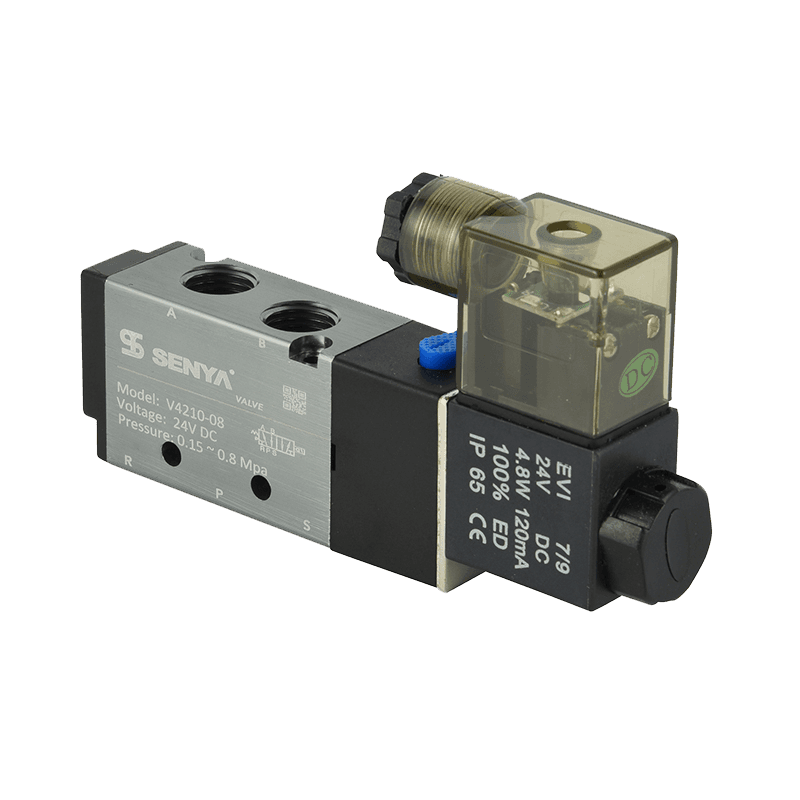 Pneumatic Directional Valve Range: Solenoid Valves and ManifoldsCompare V4 and M4 5/2 solenoid valves with SU, SV, and SW manifold options; port count helps distinguish the families for different system needs.View Product →
3/2 vs 2/2 vs 5/2: choose by actuator, not by habit
The three families solve different problems, and port count is the fastest way to tell them apart.
| Valve | Ports | Best fit | What it cannot do |
|---|---|---|---|
| 2/2 | 2 | On/off shut-off of a single line, water and steam control, pulse duty | Cannot vent the downstream line on its own |
| 3/2 | 3 | Single-acting cylinder, blow-off, vacuum, pilot signal | Cannot drive a double-acting cylinder in both directions |
| 5/2 | 5 | Double-acting cylinder, two independent work lines | Oversized and over-priced for a single-line job |
A 2/2 valve still turns up on single-acting cylinders in low-cost designs, with the air escaping back through the supply once the line is shut. It works, but the retract is slow and the exhaust path is uncontrolled. The dedicated third port gives the cylinder a short, clean route to atmosphere, which is why retract times are noticeably shorter at the same supply pressure. For a closer side-by-side, read our note on the difference between 2/2 and 3/2 solenoid valve types.
The specification checklist buyers actually need
Most returns and line stoppages trace back to a parameter nobody wrote down. Pin these down before comparing quotations:
| Parameter | What to specify | Common pitfall |
|---|---|---|
| Function and rest state | NC or NO, single or double solenoid, spring return | Ordering NC when the safe state is "held" or "clamped" |
| Port size and thread | G1/8, G1/4, NPT, or sub-base mounting | Mixing NPT and G threads on the same machine |
| Orifice and flow | Cv or Kv measured at the working pressure, not a headline figure | Sizing on a catalogue Cv taken at zero back pressure |
| Working pressure | Range, plus the minimum differential for pilot-operated bodies | Pilot types that will not shift below roughly 0.1 MPa |
| Media and seals | Air, water or inert gas; NBR, FKM or EPDM | NBR seats swelling in water-glycol or solvent media |
| Coil and duty | Voltage, AC or DC, continuous duty rating, insulation class | Running a part-duty coil continuously until it cooks |
| Protection | IP65 for washdown zones, hazardous-area certification where required | Standard coils used in car-wash or food spray areas |
| Manual override | Push or twist override for commissioning | No override, so every setup step needs power on |
| Mounting | Inline, manifold, sub-base or NAMUR | Manifold spacing that blocks access to the coil plug |
| Response time | Shift time at the real pressure and flow | Bench figures quoted on a short, dry test rig |
Installation and the failures that follow
Almost every "failed" 3/2 valve we see is a filter, a silencer or a wiring issue rather than a worn spool. The pattern is consistent enough to check in this order:
- Slow or incomplete return. Nearly always a clogged exhaust silencer or an undersized port 3 line. Pull the silencer and re-test before replacing the valve.
- Cylinder creeps while de-energized. Seat damage from pipe debris, or a poppet held open by swarf. Fit a 40 µm pre-filter ahead of the body.
- No shift, warm coil. Wrong voltage, a DC coil on an AC supply, or a duty-cycle mismatch. Compare the label against the actual supply, not against the valve it replaced.
- Chatter at changeover. Supply pressure sitting too close to the minimum pilot differential, or water in the pilot gallery after a cold shutdown.
- Leakage at port 3 when energized. A faint bleed is normal on a small spool; a continuous stream means a worn land and a replacement body.
- Erratic cycling. Loose DIN plug, oxidized pins, or a shared neutral back-feeding the coil.
For commissioning, use the manual override to confirm the air path before energizing anything, and set the air preparation unit to deliver dry, filtered air at 5 µm or better. Coils in washdown areas should have the connector pointing down so water cannot pool in the plug.
Where several single-acting actuators sit close together, an integrated manifold removes most of the tubing and the leak points that come with it.
 Conventional Pneumatic Manifold for Compact Directional Valve GroupsIntegrated manifold design reduces tubing for clustered single-acting actuators, with replaceable parts, optional D-SUB wiring, and 0.15–0.8 MPa working pressure.View Product →
Buying notes for OEM and maintenance buyers
Two valves with the same port size can differ by a factor of two in flow and by years in service life, and the datasheet rarely shows it. Ask three questions before approving a supplier:
- Is the quoted flow measured at the pressure the machine actually runs at, with the silencer fitted? A bench Cv taken without an exhaust restrictor flatters every valve on the market.
- Which seal material is fitted as standard, and can it be changed without ordering a new body? Water and glycol duty finishes NBR quickly.
- Is the coil replaceable on its own, and is the spare available in weeks rather than months? Coil failure is the most common field fault, and a valve you must replace whole stops the line for longer.
Batch consistency matters more than the first sample. A plant fitting 200 valves a month notices when spring rates drift between lots, because cycle times drift with them. Suppliers that run automated end-of-line testing on every unit, instead of sampling, are the ones whose fifth shipment matches the first.
Have a specific port size, media and rest state in mind? Send the details through our contact page and we will match them against the available bodies and coils rather than the other way round.
Frequently asked questions
What is a 3 way 2 position valve used for?
It controls one working line with a vent path: single-acting cylinders, blow-off nozzles, vacuum ejectors, pilot air for larger valves, and fill-and-dump fixtures. Whenever the line must pressurize and then empty, this is the standard choice.
What is the difference between a 3/2 and a 5/2 valve?
A 3/2 has three ports and one working line, so it suits a single-acting cylinder. A 5/2 has five ports and two working lines with two exhausts, which is what a double-acting cylinder needs to drive in both directions.
What does normally closed mean on a 3/2 valve?
At rest, with no power, the supply port is blocked and the working port is connected to exhaust, so the actuator line is vented. Energizing the coil pressurizes the line; a normally open valve reverses that behaviour.
Can a 3/2 valve operate a double-acting cylinder?
Not properly. One side of the piston would have no controlled path, so retract would depend on leakage or a manual bleed. Two separate 3/2 valves can do the job, but a single 5/2 is smaller, cheaper and easier to wire.
Poppet or spool for a 3 way valve?
Choose a poppet for near-zero leakage and tolerance of imperfect air quality. Choose a spool for compact size, faster shifting and higher flow. Both need clean, dry supply air to reach their rated life.
How do I size a 3 way 2 position valve for a cylinder?
Start with bore, stroke, cycles per minute and required extend and retract times, then convert to the air flow needed at your working pressure and add roughly 20 percent margin. Port size alone is not a flow rating.