
 简体中文
简体中文 English
 Русский
Content
- 1 The Short Answer: Ports, Positions And Flow Paths Set Them Apart
- 2 Understanding Solenoid Valve Basics Before Choosing A Type
- 3 What Is A 2/2 Way Solenoid Valve
- 4 What Is A 3/2 Way Solenoid Valve
- 5 Core Differences Between 2/2 And 3/2 Solenoid Valves
- 6 Comparing Typical Response Time Between The Two Valve Types
- 7 Flow Coefficient Trends Across Common Port Sizes
- 8 Where Water Solenoid Valves Are Commonly Applied
- 9 Side By Side Performance Radar Overview
- 10 Special Considerations For Water Solenoid Valve Selection
- 11 How To Decide Between A 2/2 Way And 3/2 Way Valve
- 12 Maintenance Habits That Extend Solenoid Valve Service Life
- 13 Manufacturing Quality Behind Reliable 2/2 Way Solenoid Valve Production
- 14 Frequently Asked Questions
- 14.1 Q1: What is the difference between 2/2 and 3/2 valves?
- 14.2 Q2: What is a normally closed valve?
- 14.3 Q3: Which voltage should I choose?
- 14.4 Q4: How long do solenoid valves last?
- 14.5 Q5: Can a solenoid valve control water?
- 14.6 Q6: Can it control steam?
- 14.7 Q7: Can a 2/2 way valve divert flow between two paths?
- 14.8 Q8: Is a 3/2 way valve suitable for simple water shutoff tasks?
The Short Answer: Ports, Positions And Flow Paths Set Them Apart
A 2/2 way solenoid valve has two ports and two working positions, so it simply opens or closes a single flow path and works as an on off switch for a liquid or gas line. A 3/2 way solenoid valve has three ports and two positions, so instead of only stopping flow it can route flow between two different paths, such as feeding a cylinder and then venting it. This structural difference is the main reason a water solenoid valve used for basic shutoff duty is almost always built around a 2/2 ways solenoid valve body, while a 3/2 way valve tends to show up in pilot control, diverting, or single acting actuator circuits.
- 2/2 way solenoid valve: 2 ports, 1 flow path, straightforward on off control
- 3/2 way solenoid valve: 3 ports, 2 flow paths, diverting or pilot signal control
- Water solenoid valve applications mostly rely on the 2/2 configuration
- 3/2 way valves are common in single acting cylinder and pilot stage circuits
Understanding Solenoid Valve Basics Before Choosing A Type
A solenoid valve is an electromechanically operated valve that uses a coil to move a plunger or armature, which in turn opens or closes an internal orifice. Because the movement is triggered electrically rather than by hand, a solenoid valve can be placed into an automated system and switched on or off from a controller, timer, sensor signal, or simple wall switch. This is why solenoid valves show up across irrigation, car washing, food processing, cooling systems, dust collection, and general industrial automation.
How A Solenoid Valve Works
When current passes through the coil, a magnetic field pulls the plunger, opening or closing the internal seat. When the coil is de-energized, a spring pushes the plunger back to its resting position. This resting position is what engineers refer to as the normal state of the valve, and it is one of the first specifications to confirm before ordering.
What Way And Position Numbers Mean
The first number in a valve description refers to the number of ports, sometimes called ways, and the second number refers to the number of positions the internal element can occupy. A 2/2 valve has two ports and two positions. A 3/2 valve has three ports and two positions. A 5/2 valve, common for double acting cylinder control, has five ports and two positions. This numbering habit is used across the pneumatic and fluid control industry to describe internal flow paths at a glance, without needing a full technical drawing.
What Is A 2/2 Way Solenoid Valve
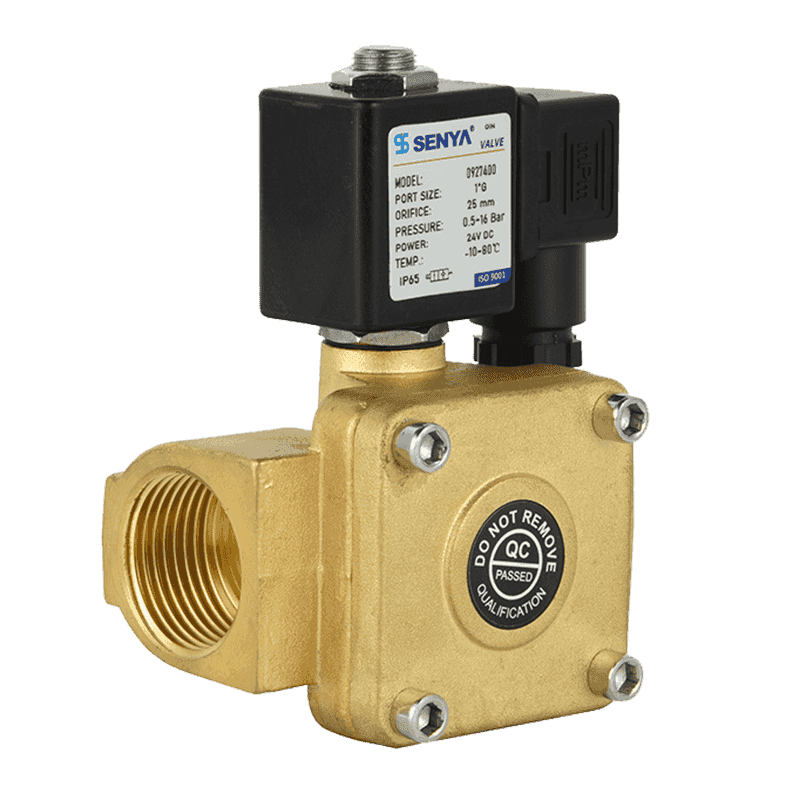
A 2/2 way solenoid valve has one inlet port and one outlet port, and it only manages a single flow path, either fully open or fully closed. There is no third connection for diverting or venting, which keeps the internal structure relatively simple and generally easier to seal reliably over long term use.
Normally Closed Versus Normally Open 2/2 Configurations
A normally closed 2/2 valve stays shut when unpowered and opens once the coil is energized. This is the more common choice because it fails to a shutoff state during a power interruption, which is a desirable safety behavior for water lines, gas lines, and many process fluids. A normally open 2/2 valve stays open when unpowered and closes once energized, and is used in specific process loops where continuous flow needs to continue by default, with an active signal required to stop it.
Typical Uses For A 2/2 Way Solenoid Valve
- Main water supply shutoff for irrigation zones
- Water inlet control for washing equipment and appliances
- Coolant and process fluid line control
- Air pulse control on dust removal filter cleaning systems
- Nozzle and line control for music fountain projects
- Simple on off air supply for basic single acting devices
What Is A 3/2 Way Solenoid Valve
A 3/2 way solenoid valve has three ports, typically described as a supply port, an outlet port that connects to the actuator, and an exhaust or vent port. In the energized position, supply connects to the outlet while the exhaust path is blocked. In the de-energized position, the outlet connects to the exhaust while the supply path is blocked, allowing pressure on the actuator side to vent out.
How The Third Port Changes Flow Behavior
Unlike a 2/2 valve, which can only start or stop flow along one path, the extra port on a 3/2 valve lets it route flow between two different destinations. This is essential for driving a single acting pneumatic cylinder, which extends under air pressure and then needs a vent path to retract using a spring or gravity return once the air signal is removed.
Typical Uses For A 3/2 Way Solenoid Valve
- Single acting pneumatic cylinder control
- Pilot valve stage ahead of a larger main valve
- Diverting flow between two separate lines
- Sampling and purge circuits
- Clamp release control on machine tooling
Core Differences Between 2/2 And 3/2 Solenoid Valves
The table below lines up the main comparison points side by side, which is often the fastest way to confirm which configuration fits an existing pipe or circuit layout.
| Comparison Point | 2/2 Way Solenoid Valve | 3/2 Way Solenoid Valve |
|---|---|---|
| Number of ports | 2 | 3 |
| Number of positions | 2 | 2 |
| Flow paths available | 1 | 2 |
| Primary function | On off shutoff | Diverting or venting |
| Normal state options | Normally closed or normally open | Normally closed or normally open outlet path |
| Common media | Water, air, mild chemicals | Compressed air, inert gas, pilot signals |
| Typical actuator pairing | None or simple on off device | Single acting cylinder or pilot stage |
| Internal structure | Simpler, fewer seals | Slightly more complex, extra seat |
Flow Coefficient Trends Across Common Port Sizes
Flow coefficient, often written as Cv, describes how much fluid can pass through a valve at a given pressure drop. A larger orifice generally gives a higher Cv. Because a 3/2 valve body has to route flow toward an extra exhaust port, its effective Cv along the main supply to outlet path is often somewhat lower than an equivalently sized 2/2 valve, since more of the internal body is dedicated to routing rather than a single straight channel. The chart below shows an illustrative trend across five common port sizes.
Where Water Solenoid Valves Are Commonly Applied
A water solenoid valve shows up across a wide range of settings, from small residential irrigation zones to larger industrial cooling loops. The chart below reflects a general estimate of where a 2/2 ways solenoid valve is most often installed in water handling systems, based on broad industry observation rather than a formal survey.
Side By Side Performance Radar Overview
To summarize the qualitative comparison across several performance traits at once, a radar style chart is often clearer than a single ranking number. The scores below are relative and simplified for illustration, covering flow control precision, diverting ability, energy efficiency, installation flexibility, response speed, and structural simplicity.
Special Considerations For Water Solenoid Valve Selection
Choosing a water solenoid valve involves a few extra checks beyond the way and position count, since water carries mineral content, temperature swings, and sometimes mild chemical additives that a pure air valve does not need to handle.
Material Compatibility With Water Media
Stainless steel bodies resist corrosion well against tap water, well water with mineral content, and mildly acidic water, which is why a corrosion resistant stainless steel option is often favored for outdoor irrigation or fountain projects that run for extended seasons. Brass bodies remain a common alternative for general municipal water lines. Seal material also matters, since EPDM seals tend to handle a wide temperature range and general water chemistry well, while NBR seals are more common where the line carries oil traces or specific process fluids.
Voltage And Coil Options
Common coil voltage options include 12V DC, 24V DC, 110V AC, and 220V AC. Low voltage DC coils are often preferred for irrigation controllers, solar powered installations, or battery backed systems, since the available power source is already low voltage. AC coils are more common in fixed building or industrial installations connected to mains power. For outdoor installations exposed to rain, dust, or splashing, a sealed coil housing helps keep the internal winding protected over years of continuous outdoor duty.
How To Decide Between A 2/2 Way And 3/2 Way Valve
The following steps summarize a practical decision path that fits most water and pneumatic control projects.
- Identify whether the application only needs to start and stop a single flow path, or needs to redirect flow between two destinations
- Check if the actuator is single acting and requires a vent path when de-energized
- Consider whether the valve will act as a pilot stage ahead of a larger main valve
- Review the media type and confirm the body and seal materials suit water, air, or another fluid
- Match the coil voltage to the available power supply on site
- Confirm port size and thread standard match the existing piping
Maintenance Habits That Extend Solenoid Valve Service Life
Routine attention keeps a water solenoid valve or pneumatic solenoid valve performing consistently over its working life. Many industrial solenoid valves are designed to reach several million operating cycles under normal operating conditions, though actual life depends heavily on media cleanliness, pressure range, and duty cycle.
- Inspect seals periodically for wear, particularly on water lines carrying sediment
- Keep the coil housing free of dust and moisture on outdoor installations
- Stay within the rated pressure and temperature range for the valve body
- Flush lines periodically to reduce mineral scale buildup on the seat
- Listen for delayed or noisy operation as an early sign of internal wear
- Schedule periodic function tests for valves used in shutoff duty
Manufacturing Quality Behind Reliable 2/2 Way Solenoid Valve Production
Ningbo SENYA Pneumatic Technology Co., Ltd. has focused on pneumatic components including valves and cylinders since 1994, following a customer value approach to product development and manufacturing. Corrosion resistant stainless steel valve bodies are processed with high concentricity level machining, and products pass through a precision automatic digital testing platform intended to support consistency across production batches. As a large scale production base, SENYA produces more than two million sets of pneumatic components such as cylinders and valves each year, with products reaching more than 30 countries including the United States, Turkey, Spain, Italy, Britain, South Korea, Australia, and Mexico. Application experience spans car washing, medical sterilizing equipment, automated production lines, mining, dust removal, music fountain projects, agricultural irrigation, solar projects, agricultural machinery, and food processing, which reflects the wide range of settings where a 2/2 ways solenoid valve or water solenoid valve needs to perform reliably day after day. SENYA also gives attention to environmental responsibility in production, supporting green product practices as part of its broader manufacturing approach.
Frequently Asked Questions
Q1: What is the difference between 2/2 and 3/2 valves?A 2/2 way valve has two ports and only opens or closes one flow path. A 3/2 way valve has three ports and can redirect flow between two paths, which usually also allows venting an actuator. |
Q2: What is a normally closed valve?A normally closed valve stays shut when there is no power to the coil and opens once the coil is energized, which is the most common configuration for shutoff duty on water and air lines. |
Q3: Which voltage should I choose?Choose the voltage that matches the available power source on site. Low voltage DC options such as 12V or 24V suit irrigation controllers and solar systems, while 110V or 220V AC suits fixed mains powered installations. |
Q4: How long do solenoid valves last?Many industrial solenoid valves are designed to reach several million operating cycles under normal conditions, though actual service life depends on media cleanliness, pressure, temperature, and duty cycle. |
Q5: Can a solenoid valve control water?Yes, a water solenoid valve built with compatible body and seal materials is commonly used to control tap water, well water, and general process water lines in a 2/2 configuration. |
Q6: Can it control steam?Some solenoid valve designs with appropriate high temperature seals and body materials can handle steam, but this requires a valve specifically rated for the pressure and temperature involved rather than a standard water valve. |
Q7: Can a 2/2 way valve divert flow between two paths?No, a 2/2 way valve only manages a single flow path. Diverting flow between two destinations requires a valve with a third port, such as a 3/2 way solenoid valve. |
Q8: Is a 3/2 way valve suitable for simple water shutoff tasks?It can work, but a 2/2 ways solenoid valve is usually the simpler and more direct choice for basic shutoff duty, since the extra port on a 3/2 valve is not needed for that function. |
.png?imageView2/2/w/326/h/326/format/jpg/q/75)
.png?imageView2/2/w/326/h/326/format/jpg/q/75)
.png?imageView2/2/w/326/h/326/format/jpg/q/75)
.png?imageView2/2/w/326/h/326/format/jpg/q/75)
.png?imageView2/2/w/326/h/326/format/jpg/q/75)